Daily log archive for Oct 2026. Go to the current daily log, or browse the archive index.
Subscribe to the weekly email digest. Check sample email out.
2026-10-31
Letting Go
What it actually means to let go
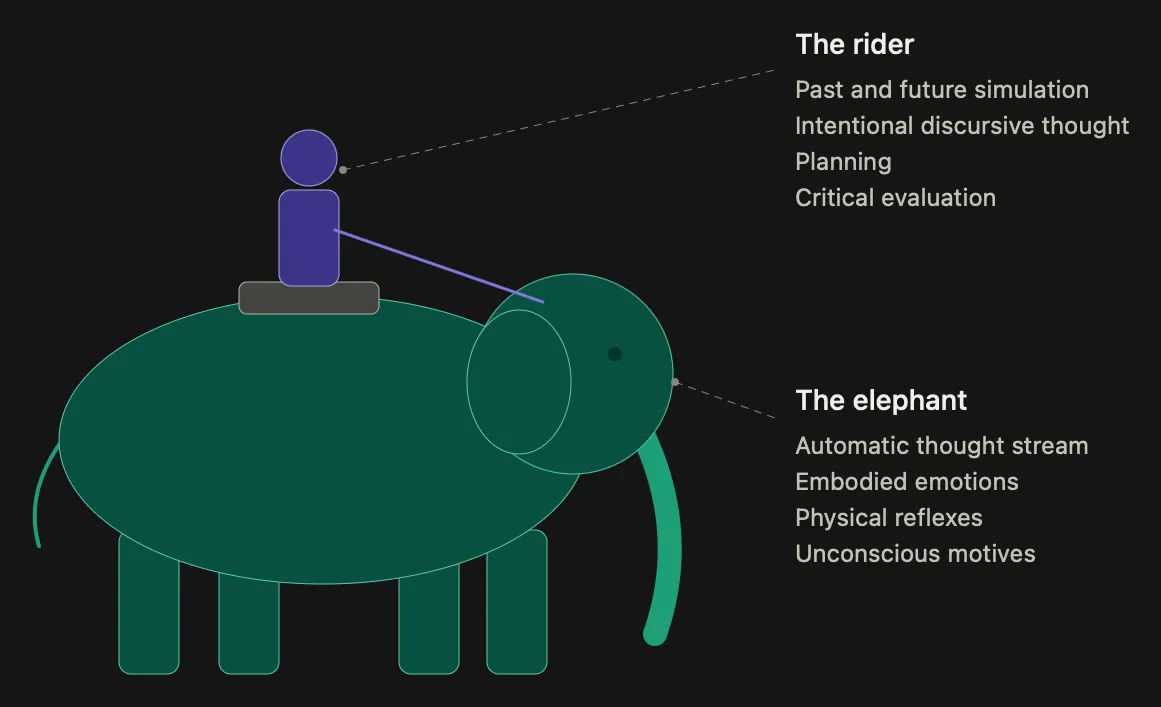
For the sake of this discussion, let’s divide the self into two parts: the elephant and the rider. The elephant is our emotional/instinctive/physical/unconscious self. The rider is our cognitive/rational/planning/judging self.
For many people, this allowing motion is most familiar from moments of physical or social abandon. Like:
- Dancing intuitively
- Saying the stupid joke that floats into your mind as soon as it arises
- Hitting things with a baseball bat in a rage room
- Surrendering into intense physical intimacy
- Allowing your body to “walk itself” during a long walk
- Falling into a rhythm in exercise
Though different in mood and intensity, all of these examples share the feeling of yielding to the process. This is what you’re looking for. Yield to the flow of experience, while remaining still. Allow breathing, feeling, perceiving, to be as they want to be.
Loved the diagram accompanying the explanation above
2026-10-30
Chris Arnade on reading novels
I read novels for entertainment, but also to learn about culture because they reflect the societies that produce them, offering an ethnographic portrait of a place and time that can be hard to access by other means, especially in the distant past.
I’m particularly interested in the archetypes they reveal — the array of roles a society makes available, the models of personhood we can inhabit. Think of character selection in a video game.
These characters change from place to place and through time — novels both portray them and can change them. National stereotypes are no longer in vogue (deservedly so when they’re used to judge individuals), but they are largely correct. They are folk ethnography, a shorthand summary of the most popular choices on a culture’s character-select screen. The Japanese salaryman, the entrepreneurial American, and the English pub-dwellers are caricatures, but they are caricatures of the most popular roles available.
I’ve written several times before about my belief that every culture does this, because it’s one of the most consequential ways thick culture1 shapes life. Humans are cultural creatures, imbued with the ability to live any type of life, but only choosing to live one. Unlike any other animal, we hold the potential for many different selves, yet we settle into just one, and that self is a manifestation of where and when we grow up.
Yet, there are plenty of differences beyond appearance, embedded into the core of who we are, and how we see ourselves — our work ethic, concepts of honor, relationship to authority, attitude toward family obligations, definition of a successful life, conception of good and evil, and our understanding of beauty, art, and leisure.
For several decades it became intellectually fashionable to try and find human cultural universals, but in the end anthropologists found none. Or none that weren’t, as Clifford Geertz noted, either too trivial (we all need food) or too abstract (we all have a sense of justice) to divine much of anything about the human condition.
That doesn’t mean any group is not human, or without a soul (I am a Catholic who believes in universal human dignity after all), but that becoming one big happy global family isn’t an easy task, certainly not one that’s a shared Coke away.
Any traveler knows this, especially modern travelers, because while globalization has rendered our physical landscapes similar, you still feel like a stranger in a strange land. When in a foreign culture you are still an alien, and with that comes all sorts of misunderstandings, confusions, and imbalances3.
2026-10-29
Work-life balance
There’s no such thing as “work-life balance”
Work-life balance is unrealistic. That’s why I aim for satisfaction. And making practical progress in these three domains: health, work, and relationships. The time split is uneven. But that doesn’t matter. Because balance is the wrong target. The goal is to feel good in all three areas. I try to protect what matters in my health and relationships. And do my best work. The fundamental rule is full presence. I’ve stopped measuring myself against a standard I can’t sustain.
The Future of Work
Working It Newsletter Oct 28 20226
2026-10-26
Sleeping after Caffeine
Biohackers Found A Way To Fall Sleep After Coffee (Maybe Forever?) | Sprudge Coffee
Here’s the thing. Biohackers are tired. You would be too if you had to wake up at 3:00am to cold plunge, get in a HIIT workout, sun your butthole, and record multiple podcast episodes before the market opens and you can start day-trading AI companies. If you’re going to stay on that grind until 8:00pm you’re going to need multiple hits of caffeine throughout the day. But you also have to sleepmaxx and that means getting to bed at 10:00pm sharp, so what are you to do? You turn to rutaecarpine.
As reported by Scientific American, many biohackers are using the supplement due to its ability to rapidly flush caffeine out of the body, thus mitigating the length of the effects. Rutaecarpine works by causing the liver to produce more of the enzyme CYP1A2, which breaks down caffeine. Thus the more CYP1A2 you have, the faster you can nullify caffeine’s effects.
The Importance of Friction
Why a world without friction is a world without progress | Aeon Essays
In conversations, few words catch my attention faster than ‘friction’ – and especially talk of making things frictionless. From the workplace to grocery shopping, our societies seem to be striving to remove friction from everything. The motivation appears to be that decreasing resistance makes life easier and smoother.
Having spent a career as a tribologist, studying friction, wear and lubrication scientifically, I have some opinions on this. I’ll confess that, in most of my career, I too have sought to reduce friction, developing new materials, designs or even instrumentation in order to lower friction in a jet engine or reduce emissions from your car. However, I’ve also found myself trying to figure out how to increase friction to remove plaque on teeth.
The reality is that friction, despite seeming so antagonistic, is necessary and even productive. The force that resists motion has, since humans first struck a spark from a stone, been the very thing that propels us forward. And this paradox offers a lens through which to reread humanity’s entire technological history.
Brain Stacking
What is brain stacking? TikTok's latest trend wants you to put down your phone
TikTok has a new suggestion for anyone worried that endless scrolling has turned their brain into mush: Pick up a book. Or a crossword puzzle. Or a Sudoku. Better yet, stack them all together.
It's called "brain stacking," and the idea is pretty simple. Instead of reaching for your phone whenever you have a spare moment, you keep a collection of books, puzzles, journals, and other mentally stimulating activities within arm's reach. Think of it as a little library of things to do when you're bored that don't involve staring at another screen.
And in an era when "brain rot" has become part of our everyday vocabulary, it's not hard to understand the appeal.
Dark Nutrition
The Proponents of ‘Dark Nutrition’ Think Everything You Know About Food Is Wrong
When I first started thinking about these people, I had just turned 31. I ate in a way that I considered normal and at least loosely healthful: I cooked at home and focused on vegetables and whole foods, though there were plenty of French fries and beer around the edges. But as my friends and I made our way into our 30s, I noticed people starting to pay more attention to health and wellness, adopting various diets and “protocols.” There seemed to be an infinite supply of options circulating online, some of them wildly experimental. When I described my fascination with the more outlandish ones to a friend, she forwarded me a PDF of Ray Peat’s “Nutrition for Women,” an esoteric book whose principles are echoed by some of today’s diet influencers. Ah, my friend said, dark nutrition.
That was it: The term seemed to encompass everything from Kelly Pi’s eating to the people I’d seen promoting the health benefits of Coca-Cola. Dark nutrition wasn’t a specific diet; it was a style of thinking about food and health. Its adherents had concluded that the usual sources of authority — doctors, public health officials, food executives, pharmaceutical corporations — could not be trusted. The old order that told us to eat our vegetables was discarded. New ideas emerged, via podcasts and Instagram accounts and message boards, to fill the void. These perspectives didn’t all fit together; there were arguments over low fat versus high fat, low carb versus high sugar, Silicon Valley biohacking versus strains of naturopathy that approached mysticism. Still, these realms collided and overlapped. “The raw-milk guys and homesteading girls are watching each other’s reels now,” says Sami Reiss, who writes a popular newsletter about nutrition and wellness. “Whatever walls existed between those groups are disappearing.”
2026-10-24
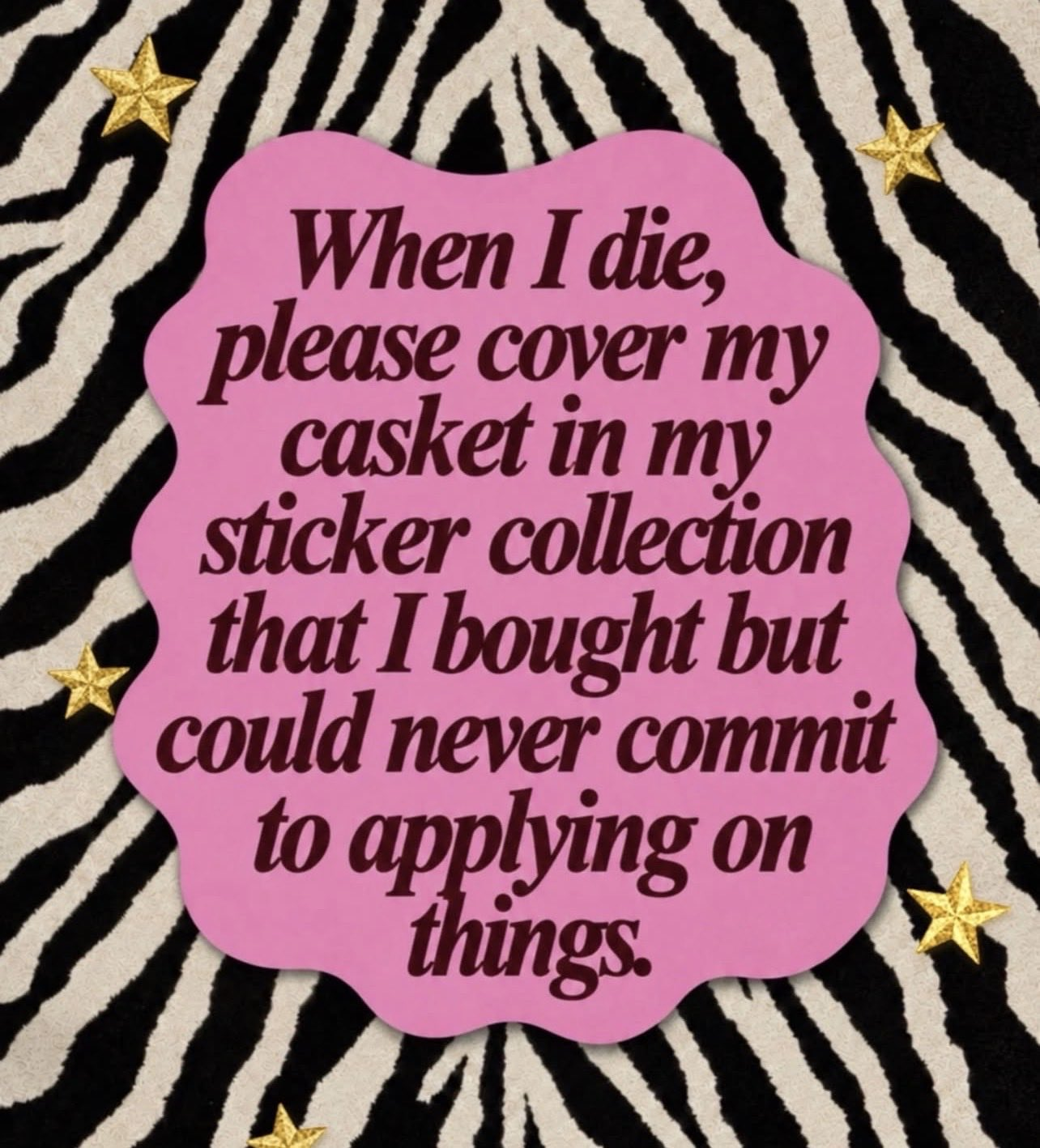
Stickers
Very relatable
2026-10-22
Groupish Fads
As the sparks fly upward, we complexify
At this point in the thinkboi Substackosphere, most people have encountered Kegan’s theory of adult development. The core of this idea is: adults don’t stop mentally developing at puberty. Instead, throughout our lives, we advance through stages of mental complexity, as our environment demands it. Each stage of development is a shift in how we compose reality—where we get our notion of truth, and how we construct our identity.
These stages are:
1, the impulsive mode (young children)—very little split between subject and object, you are totally merged with your wants and feelings, you act when there’s an impulse to act.
2, the imperial mode (adolescents, maybe 10% of adults)—life is about meeting your own needs, other people are experienced as antagonists or allies in this effort.
3, the socialized mode (over 50% of adults)—what is good and true is judged by the feelings of others. Emphasis on relationships, fitting in, inhibiting desires.
4, the self-authored mode (less than 50% of adults)—where what is good and true is judged by an inner compass. Emphasis on authenticity, consistency, reconnecting with fully owned desires.
5, the self-transforming mode (a few %)—where the inner compass has been seen as only one of infinite potential systems, each with upsides and limitations. Emphasis on fluidity, paradox, meaning-making as an ongoing activity.
Around every idea, a groupish fad will exist
Have you ever wondered why, in Buddhist meditation circles, the stated idea is to deconstruct self-identity, but everyone talks the same, as if the real point is becoming the dullest vegetarian possible? Or why “contrarian first-principle thinkers” in the Bay, 6 years ago, all had the same ideas about what kinds of business to start? Or why there’s such a thing as “therapy culture,” which has little to do with what typically goes on in analyst’s offices, but is rather a watered-down collection of speech norms developed on social networks, used to torture hapless single men?
Kegan ends our confusion. There is an elegant reading of the above phenomena: for people in a socialized mode, ideas exist as components of group identities. When the Zen teacher says to people in the socialized mode, “when you meet the Buddha on the road, kill the Buddha,” what the socialized mode pupils hear is, “got it, we should act like our Buddha-killing teacher.”
In other words, every philosophy that advocates individual self-development will get codified, by its Stage 3 adherents, into an aesthetic, a set of collectively enforced priorities.
Dogmatism is a feature of humanity, not something that can be debugged
People’s realities are constituted by dogmatism, of differing levels of sophistication. In the socialized mode, the dogmatism is tribal. In the self-authored mode, the dogmatism is a system of truth, which organizes perception well enough, but makes certain thoughts unthinkable. Relatively few people abandon the prospect of a rigid system of values—and, when they do, it’s mostly as they approach middle age, in response to life’s increasing complexity, not an education about critical thinking.
And, this is Good, Actually. Do you think you’d be able to teach a band of rowdy teenagers why group cohesion is a good idea, via philosophical reasoning?
Recently, while I was commuting in New York, I marveled at the harmony of civilization, how so many with disparate priorities can peacefully coexist in public. On a given subway car, you have young Marxists who feel that society is being torn apart by capitalists, and corporate lawyers working out the multinational wranglings of giant enterprises. Both maintain this truce without thinking, keeping conflict mostly in the realm of Twitter or the voting booth. As anthropologist Sarah Blaffer Hrdy pointed out, if you put a bunch of rival chimpanzees on a cross-country flight, you’d have a massacre on landing. But a cross-country flight of rival humans is, like, every flight. If people didn’t have a baked-in tendency towards groupthink we would tear each other to shreds. As it is, our default tendency is to say “bless you” when our enemy sneezes.
2026-10-20
GenZ protests
Gen Z are taking to the streets around the world – here’s why
Something’s happening in the streets. This weekend, the world’s youth seemingly erupted into protest: teenagers and students mobilised across France and Belgium; young Albanians called for their prime minister’s resignation; and India’s youth-led Cockroach movement continued to challenge controversial changes to voter rolls. In Santiago, protesters marked the anniversary of Chile’s 2019 uprising by marching against government spending cuts. Elsewhere, crowds packed the streets of Lisbon and Milan to protest soaring living costs, while demonstrations in Brazil and the US turned attention towards democracy.
From classrooms to the ballot box, we explore what’s driving the unrest – and what protesters are demanding.
2026-10-18
Monstrous times
Came across this quote originally from Antonio Gramsci and embellished by Slavoj Žižek
The old world is dying, the new world struggles to be born, and now is the time of monsters.
From this article: Six Collisions for Protocol Monsters
2026-10-17
Hotspan
Forget Healthspan. Midlife Men Face Pressure to Extend ‘Hotspan’
Americans have become obsessed with longevity, extending not just our lifespan but also our “healthspan” — how long we live healthfully and happily. As a result, what middle age looks like has shifted too, thanks to everything from skincare to surgery. If we feel young and healthy on the inside, why wouldn’t we want to look that way on the outside? Now we’re all about extending our “hotspan.”
This perspective shift is more substantial for aging men, upon whom pop culture and society have traditionally set lower expectations of health and appearance. (This was explained most brilliantly, and unprintably, in an unforgettable Inside Amy Schumer sketch from 2015.) Millions now tune into “manosphere” podcasts extolling the importance — nay, necessity — of keeping up one’s vitality. And it’s about time: Women, of course, have felt pressure to stay hot forever since … forever.
2026-10-14
Perry Mehrling RIP
Perry Mehrling is no more and I teared up a little today morning when I learnt of his passing. His series of lectures on Money and Banking were a huge influence on me several years ago. I use his quote "Liquidity kills you quick" all the time with unsuspecting folks who sometimes don't realise how profound that statement really is.
Superstar podcasts are Silicon Valley’s way of talking to itself
Superstar podcasts are Silicon Valley’s way of talking to itself
All share an in-crowd mystique bordering on incestuousness. In April OpenAI reportedly spent $100m-200m to buy then-18-month-old TBPN (though there was no mention of the affiliation during Mr Altman’s interview). The “All-In” hosts are self-described “besties” with many of their billionaire interviewees. In San Francisco Mr Patel has shared digs with Anthropic’s researchers. They are fascinated by AI, which they talk about with passionate intensity and expertise. They are also an echo chamber, with a tin ear at times to the concerns of the rest of America.
But the rise of social media and the growing power and wealth of big tech generated a rift between Silicon Valley and news outlets. Mr Battelle says that parts of the tech establishment started to view traditional media as “anti-American” for questioning the “dominance of the tech hierarchy”. For their part, old media, whose business model has been hurt by the tech giants, sometimes smell of sour grapes. Podcasters, who share their guests’ techno-optimism, provide a friendlier platform.
Instead, AI is at the centre of their discussions. Unlike many parts of America, they treat it as almost the only topic worth discussing. But this obsession has further pushed Silicon Valley into a “monoculture”, says David Senra, an influential podcaster. Recently he has been to tech dinners where conversation veers only between AI optimism and doomerism. “It sounds like they are all reading the same tweets,” he says.
If all else fails, they can podcast from Mars. But will people still want to listen to them?
Learning as a social activity
Want to be a lifelong learner? Don’t go it alone | Psyche Ideas
The internet is full of resources for self-directed learning: for any subject, you can easily find blog posts about essential texts, links to university syllabi, and hours of YouTube lectures. When I attempted to make use of these guides, however, I often found myself disengaged and unfocused. I chastised myself for scrolling through social media while watching online lectures, or forgetting most of the ideas inside the books I read.
The problem, however, wasn’t my attention span. It was my approach: I was struggling because I saw learning as a solitary pursuit.
My interest in self-directed learning eventually led me to the Brazilian philosopher Paulo Freire, one of the most influential educational theorists of the 20th century. In his impassioned manifesto Pedagogy of the Oppressed (1968), he criticised the idea that ‘the teacher teaches and the students are taught … the teacher knows everything and the students know nothing.’ True learning, Freire believed, could be accomplished only ‘through the restless, impatient, continuing, hopeful inquiry human beings pursue in the world, with the world, and with each other.’
…But stories like these helped me realise that a formal education is, for many, only the beginning of one’s intellectual and creative life. I began, slowly but surely, to piece together what my own intellectual life looked like: taking online classes with writers and literary scholars; joining in-person book clubs to deepen my understanding of challenging texts; and finding friends who offered generous, useful feedback on my work.
Relationships like these might be the most important resource for learning something new. You can teach yourself almost anything, it turns out, within a community of encouraging and intellectually ambitious peers.
The Woman Who Wants You to Ditch Your Phone
The Woman Who Wants You to Ditch Your Phone
At the park, Lamm wore a thrifted black top with a paper clip in place of a missing button. She appears somewhat out of time, her face cleansed of TikTok makeup trends and her silhouette freed from the long jorts that have seemingly drop-shipped onto everyone in her age bracket. Unled by Google, unfed by DoorDash, unmatched on Hinge, she navigates a version of New York where seemingly everyone else is locked in a tragic embrace with a personal device. When she walks outside, she is now the rare human who is alert and open for engagement.
Theory-free AI
In "theory-free AI," a programmer does not create a software model of reality and then ask a machine-learning system to use statistical insights from its training data to guess at how to operate over that model. Rather, the programmer shovels vastly more training data into the AI's inbox and uses titanic amounts of computing power to analyze that data and find statistical relationships without trying to explain them.
The fact that a theory-free AI might demand far more cash to accomplish a task (even a "solved" one like playing chess) than an expert would charge is beside the point. Billionaires have money, they don't have expertise. Theory-free inference is a bid to substitute one for the other: the beauty and terror of being able to manipulate the world without studying or understanding it is that it can be done with money alone. No experts needed.
2026-10-08
Headphones and GenZ
Headphones are turning my Gen Z peers into idiots
Although to be fair this problem is not just endemic in GenZ.
The most obvious and probably most important detail is that we are funnelling so much of our attention through our ears. That would be worthwhile if we were imbibing material that we could value. From what I’ve heard – they’re not soundproof, you know – the majority listen to music while they commute. Music is fabulous, but we are nostalgic creatures, and more often than not these will be tunes we already know, and can mouth along to. It feels good, but how can we notice what we are hearing in the rush of the tube, or traffic?
Podcasts are no better. The great cultural theorist Walter Ong writes how difficult it is to convey intricate chronologies and complex relationships orally. Generally, auditory media are more distancing than involving, as we are cut off from the rest of the world. Reading, the obvious alternative, is a formidable neurological feat, intertwining value judgments and necessary empathy. Headphones in, we isolate ourselves from the full environment indispensable to human responsiveness. A colleague might tell you what they were talking about on The Rest is History last week; now enjoy their wide-eyed panic when you query a single specific detail.
Here, the major, pitiable folly is that our headphone obsession seems to induce a collective act of avoidance. Those who wear headphones are scarily impulsive, clutching for them and sliding them on ahead of a five-minute walk because it is easier than walking along with their thoughts. Many of my friends can’t read without a headphone in one ear. They are fiends for constant distraction; useful boredom – Nietzsche’s “unpleasant calm of the soul” – is being eliminated.
This has annoying consequences for all of us. Rudeness, chiefly, and the dying away of the small, valuable conversations that now can’t be had without an awkward gesture and the pronounced mouthing of “take them off”. Worse still, for many, the sounds of the world around them have virtually vanished, drowned by the voices and noises in their ears.
2026-10-07
Nimesh in Brooklyn Coffee Shop
Brooklyn Coffee Shop Episode 95 ft. @Findingnimesh
I am manifesting a life like Nimesh's character in this episode of Brooklyn Coffee Shop. I watched it like 7 times already!!! 😂
2026-10-06
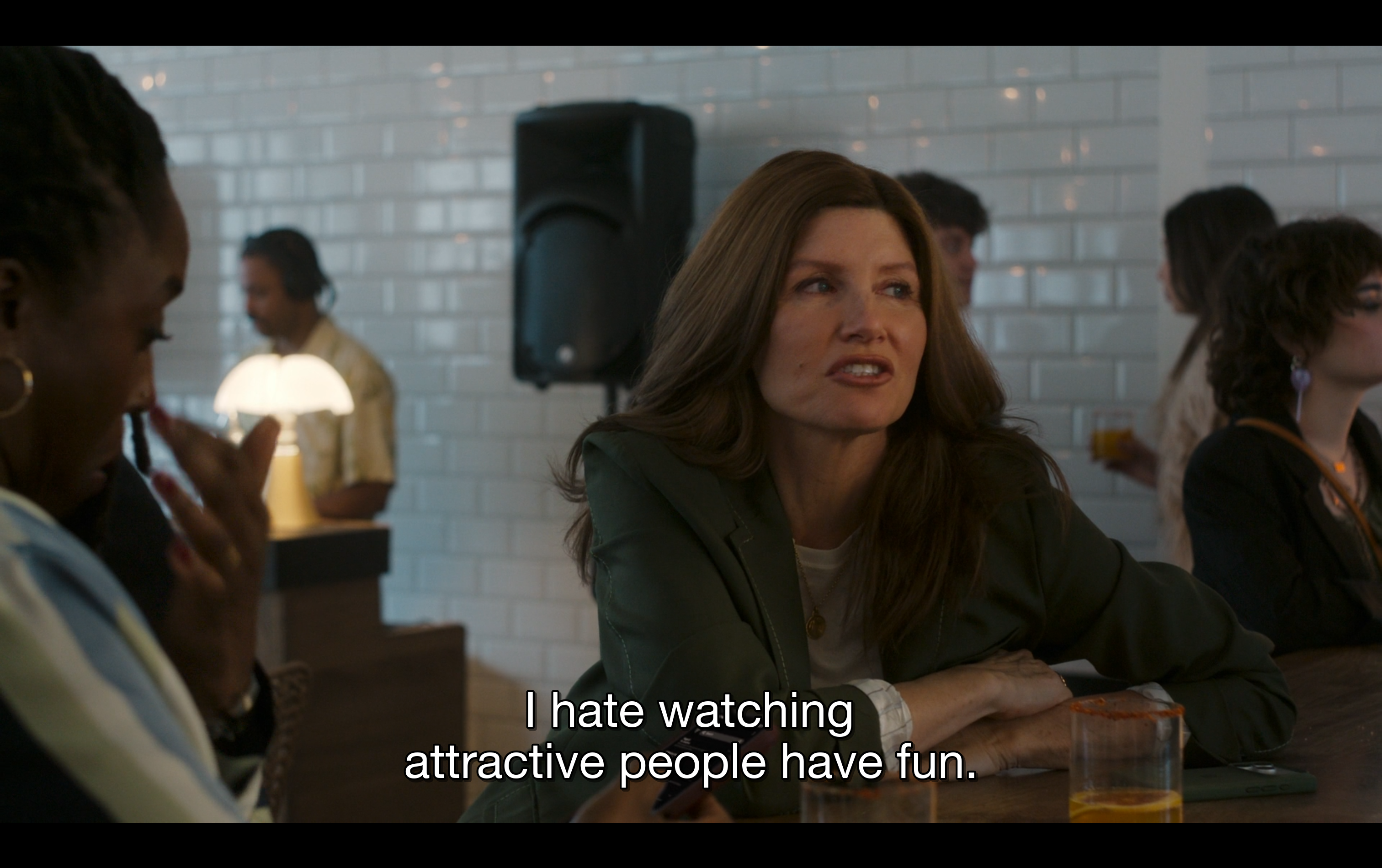
Youth
Youth (TV Series 2026– ) ⭐ 6.5 | Comedy, Drama #tv
Been watching this new TV show and loving it so far.
2026-10-03
LinkedIn LARPMaxxing
LinkedIn is a soul-sucking hole of professionalism and a pit of hell that not even my worst enemy should spend the rest of his days in.
It’s this concoction of performative productivity and corpo speak producing cursed artifacts beyond human comprehension.
A place where normal human text goes to die and can only be kept alive by an LLM like a radiation protection suit.
And I wanted to look into the performative projects people keep making that are all over my feed.
That’s the real problem. Nothing on that site rewards you for getting better. It’s a platform built around selling yourself for a job, so what survives isn’t skill; it’s looking interesting. It’s just LARPing productivity. Go to some of these profiles, and it’s the same guy detecting potholes over and over and over with zero signs of improvement.
2026-10-01
AI Book Recs
AI book recs are making us all read the same thing #books
But, she adds: “AI destroys individual taste.” And in an age of constant online bombardment and soulless algorithms, cultivating your own taste feels more important than ever. If you’re getting the same reading recs as everyone else who types into Gemini that they loved Demon Copperhead, you may get a quick result, but it encourages a boring, conformist culture dominated by a handful of best-selling authors. You're not going to diversify your reading to the same degree as talking to your local bookseller or taking the time to browse the shelves. Something as routine as choosing a book can still be a creative task. As Bret Stephens writes in the New York Times: “We become more creative when we learn how to put a personal stamp even on routine things, making them unmistakably our own.”
Skilled Trades in place of AI
So You Think You Could Be An Electrician?
This is a sobering look at being employed in the skilled trades (plumber, electrician etc) from somebody who has been doing this for a while.
In the first place, college graduates still earn more than those without college degrees, specifically because of their academic credentials. In casual settings, people often fail to disentangle selection effects, but rigorous causal research actually does find substantial income effects of college graduation, often amounting to hundreds of thousands of dollars over the course of a career, though this can vary across majors. Completion of a four-year degree is critical to the earnings leap.
There’s moderate evidence that people in wealthy countries are increasingly risk-averse to things that might kill or harm them. For many folks, this may translate to an unwillingness to take on a nontrivial risk of death or injury via dangerous jobs. And there may be a subtler version of this in which people are reluctant to tinker with physical objects for fear of destroying them. I’ve found that when I coach people through DIY projects, they’re often extraordinarily fearful. And not just of electrocution or falling, but of doing something incorrectly or pushing a broken thing past the point of being reparable. (And this appears to be something that blue-collar people — perhaps due to hubris or ignorance — don’t seem to worry about as much.)
While the optimal quantity of risk-taking for a given job probably isn’t zero, it’s difficult to broadly argue against placing a high intrinsic value on human life or the avoidance of pain and chronic disability. People abandoning the trades for safe, high-paying jobs is understandable.
Trades jobs are generally among the best blue-collar jobs, and within the trades, specialized union jobs are especially coveted. These jobs are less accessible to people on the lower end of the blue-collar hierarchy. They often require training, social connections, certifications and licensing, and technical competence. I asked several acquaintances in union trades about the selection process for their jobs. Each described an initial process with 100 to 200 candidates, followed by testing and interviews that winnowed the field to one to two dozen. The final selection of between four and eight job entrants was less clear but appeared to include a mix of connections, previous credentials such as military service, and measured ability.
this bit about the usage of AI in the skilled trades was really interesting
With improvements to video interpretation capabilities, AI could remove much of the complexity from the minds of human tradespeople. For instance, a future job site worker equipped with smart glasses and an earpiece might receive continuous direction via an AI interpreting and providing feedback on their actions. In some cases this is similar to the way I occasionally use LLMs, although at a lower level. It’s much faster to ask for torque specifications via an earpiece than to reference a manual. One of the most failure-prone jobs in residential HVAC, for example, is setting airflow. A technician might install or service a dozen manufacturers, each with three varieties of fan type and dozens of models each with unique switch set points. On complex HVAC installations there may be dozens or even hundreds of reference points such as these. Many are nearly impossible to memorize or reasonably guess. An AI with good access to the technician’s field of view and perfect equipment knowledge could readily coach dumb hands through this task.
Managers of Machines
Citadel Hunts for ‘Managers of Machines’ in Quant Hiring Push
Manager of Machines could turn out to be a common title on LinkedIn
“People can now effectively manage two, four, and in some cases even more processes. Humans are now also becoming ‘managers of machines’,” said Arora. “Those humans, unlike machines, are not easily replaced.”