Daily log archive for Apr 2026. Go to the current daily log, or browse the archive index.
Subscribe to the weekly email digest. Check sample email out.
2026-04-30
This Japanese art of breaking from routine
Life is meant to be experienced, not endured.
If everything feels predictable or mechanical, I wake myself up with awe or an element of surprise. I give myself a break from monotony to bring wonder back. And keep life from becoming stagnant.
The Japanese call it datsuzoku.
Datsu means “to escape”, “to flee” and zoku can be translated as “routine” or “convention”. It’s a practice of breaking out of routine, “escaping from the usual” or “stepping outside the ordinary.” Also of freeing yourself from patterns that take away that “alive” feeling of being human.
Datsuzoku is all about surprise.
Freedom from the usual. The kind of break that shocks you into awareness. It’s not just unwinding; it’s reconnecting with a side of life that’s alive, unpredictable. Breaking patterns keeps the mind alert and excited.
Investing
The Robots Make the Predictions - Bloomberg
I wrote last week that, in investing, “There’s no magic, no dark matter, no other source of gains. Everyone’s gains come from (1) economic growth and (2) other people’s losses.” In the aggregate, everyone gets the market return, which comes from allocating capital to economic growth. Some people get more and others get less, but they necessarily cancel each other out. People invest anyway, though, because allocating capital to economic growth is a good long-term proposition.
Prediction markets don’t have that. People put $1 into a prediction market event contract, and at resolution it pays out $1 to the winner. There is no investment in economic growth, no source of long-term returns; everyone’s winnings come from someone else’s losses.
2026-04-29
Post-romanticism
Podcast: 🆕 Never Post! Why No One Wants to Hard Launch Their Man #relationships #dating
Transcript: Never Post - Why No One Wants to Hard Launch Their Man | Transcript Reader
The whole podcast is worth listening to, but this term "post-romanticism" caught my eye. This is probably the first time I am encountering it.
There's a cheery fatalism here. If the marketplace of love offered you a freedom of endless choices, then this new mindset offered freedom from choosing it all. And Carolina explained to me that this ushered in a new kind of dating landscape. Some refer to it as heterofatalism or heteropessimism. But in our conversation, Carolina called it post romanticism.
This post romantic vibe or mood is characterized by sort of a loss of faith in romanticism, of a disbelief in romanticism or at least a performative disbelief in the romantic plot, which is seen not only as a myth, but also as a potentially danger of oppressive one.
Post romanticism trades the emotionally ruinous experience of situationships and ghosting and gaslighting for a completely sanitized view of dating that does not allow for any risk of getting hurt at all. The simplest solution would be to never date men ever. But under post romanticism, you can date. You can have sex. You can have fun if you want to.
But you do so with a kind of intense vigilance that borders on the hypochondriac.
think what is at stake, it's a reversal of the romantic idea of love. Roland Barthes in the Fragments of a Lovers Discourse says that the lover, the 1 who love wants to be loved back so that to become perfect. It is the love I receive that makes me perfect. Whereas in the post romantic discourse, you have to be perfect in order to deserve to be loved. I don't think there is ever a world where you will dine at the table of post romanticism and leave with your belly full. It's a crash diet of avoidance to vulnerability, a commitment to your own misery and the expected misery of others as if it's an intellectual win. But all it really does is make everything so much harder for everyone.
Tech bros and Gutka
The Tech Bros Are All In on Zyn
Everytime I hear Zyn, my mind goes to Gutka.
Gutka is a type of betel quid and chewing tobacco preparation made of crushed areca nut (also called betel nut), tobacco, catechu, paraffin wax, slaked lime (calcium hydroxide) and sweet or savory flavourings, in India, Pakistan, other Asian countries, and North America.
The article is kinda wild.
Entrepreneur Garrett Campbell has a 6-mg “cool mint” Zyn tucked under his lip at all times during his mammoth 15-hour workdays, aside from when he is eating.
“I was always very against nicotine,” says the software company founder. The 26-year-old saw his peers using nicotine pouches at college, when they first emerged as a potential productivity-boosting hack, and considered it a “degenerate thing to do.”
But then all of his fellow founders started fueling themselves with nicotine pouches, of which the Philip Morris International–owned Zyn is the market leader. The company distributed 794 million cans in the US in the last financial year, a 37 percent increase over the previous year. Now, Campbell says “every single one” of his friends that runs a company does so with a nicotine pouch in their mouth.
“The brand marketer person [is] doing a hell of a job,” says Campbell, who has slicked-back dark hair and usually wears plain T-shirts in black, white, or gray. He also has ADHD and sold a sales recruitment company last year for a “good chunk of change.”
Nicotine’s core mechanism hasn’t changed in the journey from puff to pouch; the compound still floods the brain with dopamine. Dependence develops quickly, but for some users in the tech sector, the rush of productivity balances out the risk of dependency.
But how “clean” really are the pouches? A gulf is swiftly emerging between nicotine advocates who use the pouches and those who use toothpicks, lozenges, pills, patches, or sprays. Biohacking guru and author Dave Asprey describes nicotine as being close to a perfect psychotropic. “If you're under-aroused, it brings you up; over-aroused, it brings you down,” he says.
…
Nicotine is perhaps the only “biohacking tool” that encounters such strident opposition in other circles. Fellow biohacker Bryan Johnson is against nicotine entirely, and not only due to his claims that the pouches can cause gum recession, oral lesions, and irritation.
2026-04-28
Most People Dont Have a Type
Most People Don’t Have a ‘Type’ #dating #relationships
This is not an uncommon trajectory. Many people think that they have a set type, and that all they need for eternal bliss is to find someone who matches it. When people peruse dating profiles, they’re often looking for someone who has specific interests, qualities, or hobbies. But according to a growing body of relationship research, many people end up marrying someone with few of their must-haves and a lot of “haves” they didn’t think they desired. A person might say that they’re looking for a partner who’s funny and conscientious, but then end up in a happy relationship with someone who is neither of those things. “People don’t know what they want,” Samantha Joel, a psychologist at Western University in Ontario who studies relationships, told me, “and people don’t know what they’re going to like until they meet someone.”
That said, shared values do seem to matter to people: A 2020 report found that only 3 percent of American adults were married to someone from the opposite political party, for instance. Eastwick says that this happens because so many people either immediately screen out or simply never interact with a potential date who has opposing values—a hard-core Democrat might live in a neighborhood populated mostly with other Democrats, for example, or swipe left on all Republicans on Tinder. But if two people get together not knowing that they’re political opposites and the relationship takes off for other reasons, they might compartmentalize their differences or move closer to each other’s ideology. (“He’s probably going to become a libertarian,” Eastwick said, referring to the hypothetical Republican.)
The problem is: The way people actually become attracted to each other can be hard to predict, Joel said. Not even scientists who have dedicated their life to studying chemistry can totally pin down its essence. Do you like the guy from Tinder and the joke he cracked about The Big Lebowski just because you were in an unusually good mood on the day you met up with him? If you’d been in a rotten mood, would you have liked him (and his stupid joke) less?
…
All of this might help explain why many people who use dating apps struggle to find a long-term partner. With their emphasis on photos and profiles, Eastwick writes, “apps cater to our ideas about what we like much better than they cater to what we actually like.” Chemistry grows, and love is built on shared experiences and memories, but the apps tend to keep people trapped in small talk. Many users find themselves swiping endlessly without ever meeting up with someone. What’s more, Eastwick told me, apps can encourage people to judge their dates too quickly—and perhaps move on prematurely. “You might have a middling first impression of somebody,” he said, “but then you meet them again, and you end up really liking them.” The apps, however, present so many options that if a date is “anywhere south of great,” people may be inclined to hastily decide “I’m not gonna do the second date.”
2026-04-27
Marriage and Settling
Are on-screen relationships normalising settling? | Dazed
Very similar themes to the New Yorker podcast I logged last week.
What is marriage for? It’s an interesting question in our day and age, when marriage feels less and less necessary. Women are no longer as dependent on men for financial security (although many still are), and there is far less social stigma around having children or living together outside of wedlock. We also know that a significant amount of marriages don't last, with approximately 42 per cent in the UK projected to end in divorce before their 25th year. So why are we still so drawn to the fantasies of this institution?
This is one of the underlying questions of season two of award-winning Netflix drama Beef. Several answers are explored through the series’ three main couples: Josh and Lindsay (Oscar Isaac and Carey Mulligan), Ashley and Austin (Cailee Spaeny and Charles Melton), and Chairwoman Park and Dr Kim (Youn Yuh-jung and Song Kang-ho). In episode six, Chairwoman Park, bogged down by efforts to cover up her husband’s culpability in a patient’s death, speaks candidly about why she married him: “This is such a headache! The whole reason I remarried was because he was fun. Someone to eat with. To travel with. That’s all.”
People get married for all kinds of reasons: family and societal pressures, visas, economic and financial security, and, of course, love. But one of the most common motivations is the simple fact that people don’t want to be alone. A 2024 survey commissioned by Forbes Advisor, which polled 1,000 divorced Americans, found that companionship was the second most common reason for getting married, with financial security first and love third. On Reddit, marriage forums are full of questions about marriage and loneliness, with one user questioning whether the idea that “you should never marry out of fear of ending up alone” makes any sense. “Isn’t [that] really the only reason to get married?” they ask. “If people seek stability and companionship, they get married.”
In a climactic exchange in the final episode, Chairwoman Park offers a jaundiced view of love under capitalism: “Love lives in this system. All relationships exist in this system. They are all the same, another way to serve the self.” Marriage is supposed to save you from loneliness. It is supposed to grant you rights and signal to the world that you are lovable, desirable, chosen.
I don’t want to spoil the ending of Beef – it is messy, complicated, depressing and unsatisfying, in ways both good and bad. But it shows that while marriage is often an attempt to ameliorate the loneliness of being alive, it can sometimes make that loneliness even worse. It is only in allowing ourselves to be seen and known, helped and supported by others in our best and worst moments, that we can, as Lindsay tells Ashley, “finally give our existence some semblance of meaning.” This might also teach us how to genuinely love one another: not by force, or out of desperation, but truly by choice.
Geopolitics and Economy
Came across a couple of podcasts related to this theme.
Fertilizer 101 How the war with Iran and Hormuz crisis is upending fertilizer supply chains. However, beyond just the current news cycle, this episode goes really deep into how the fertilizer supply chain is organized.
Rare Earths and China Traces the history of the discovery of these rare earths and how eventually China came to dominate them.
- Episode: Battlefield rare earths: How the U.S. lost to China - YouTube
- Transcript: Planet Money - Battlefield rare earths: How the U.S. lost to China | Transcript Reader
2026-04-26
Janteloven
Is the Scandi ethos of Janteloven broken?
I have been hearing this term for a while now, and I started to pay attention to it because I work for a Danish company nowadays.
Janteloven — or Law of Jante — is an informal, often misunderstood, set of rules taken from the satirical novel A Fugitive Crosses His Tracks (1933) by the Danish-Norwegian novelist Aksel Sandemose. The ten rules, all variations on not acting ostentatiously, were a critique of oppressive rural communities in Norway.
In the years since, Sandemose’s fictional creation has become conflated with broader ideas of Scandinavian equality, a regional brand of solidarity and togetherness recognised around the world. Viewed positively, Janteloven can be linked to Dugnad, the Norwegian tradition of communal volunteer work in parks and schools, while a lack of overt competition lessens loneliness. But it has also been criticised for stifling innovation. And if being transparent in one’s ambitions is frowned upon, one might be tempted into shady territory.
While the article above 👆🏽 doesn't go into what the exact laws are, I found this article which does.
What is Janteloven? The Law of Jante in Scandinavian Society
According to this article:
Janteloven’s social code dictates emphasis on collective accomplishments and well-being, and disdains focus on individual achievements. It is an underlying Scandinavian philosophy principle that applies across Denmark, Norway, Sweden, Finland, and Iceland. Understanding Janteloven is paramount to understanding both the history and modern-day cultures of these countries.
The ten rules of Janteloven are:
- Don’t think you are anything special.
- Don’t think you are as good as we are.
- Don’t think you are smarter than we are.
- Don’t think you are better than we are.
- Don’t think you know more than we do.
- Don’t think you are more important than we are.
- Don’t think you are good at anything.
- Don’t laugh at us.
- Don’t think anyone cares about you.
- Don’t think you can teach us anything.
Random (but good) Advice from Ava
some things I've learned about dealing with people - by Ava
Being comfortable in large groups and parties is just a learned skill. For many years, I identified as someone who was very comfortable in one-on-one settings, but unsure of how to socialize in groups. Then I started hosting more parties and events for work and realized I’d mythologized this “comfortable in small groups/comfortable in big groups” thing way too much. It’s literally just a thing you teach yourself how to do. Assume a normal and friendly affect! Talk to people sincerely and unpretentiously! Circulate! If needed, break it down into a set of procedural steps—this is how I enter a conversation with a group of people I don’t know, this is how I leave the conversation when I’m bored.
would love to adopt this 👆🏽
Don’t let not texting someone back for a very long time stop you from doing the above.
Glennon Doyle: “Your job throughout your entire life, is to disappoint as many people as it takes to avoid disappointing yourself.”
2026-04-23
Anxiety
The Meaning of Anxiety | A Working Library #books #mentalhealth
Rollo May refutes the assertion that mental health is living without anxiety, proposing instead that anxiety is a necessary condition for creativity, intellect, and freedom. He defines anxiety as the “experience of Being affirming itself against Nonbeing,” as that which propels us to more self-awareness, consciousness, and life. He likewise shows that the refusal to embrace this anxiety, to attend to it and work with it and through it, is an invitation to authoritarianism and fascism. When we lack the skills of being with our anxiety, and feel our only option is to flee, we often flee right into the hands of a strongman who promises security at the cost of liberty. May wrote during the height of fascism in the last century; we read it during the renewal of the same in this one. The lessons hold.
this is such a great quote from the book being talked about
It is to be expected that certain “mechanisms of escape” from the situation of isolation and anxiety should have developed. The mechanism most frequently employed in our culture, [Erich] Fromm believes, is that of automation conformity. An individual “adopts entirely the kind of personality offered to him [sic] by cultural patterns; and he therefore becomes exactly as all others are and as they expect him to be.” This conformity proceeds on the assumption that the “person who gives up his individual self and becomes an automaton, identical with millions of other automatons around him, need not feel alone and anxious any more.”
This is the trap anxiety lays for us: in our effort to escape it, we run further into its jaws. But perhaps there are yet alternatives. May connects that impulse to escape with the experience of isolation: can we become less isolated without becoming automatons? Can we find community not in the center, but on the outskirts, among the weirdos and the outsiders, the people who never seem to fit in, who are always playing a different game? There are fewer of them, by definition, but not so few that we cannot find them. We won’t find the comfort of the majority among them, of course—but as we have seen, that comfort is mere illusion—but perhaps we can find the community and camaraderie that is so necessary for our survival, and without giving up our precious selves to get it.
Matt Levine on the SpaceX IPO and the Cursor acquisition
There’s No Time for SpaceX to Buy Cursor - Bloomberg
I havent been setting aside time to read Matt Levine's newsletter often enough. But this one is gold
Part of what you are getting, when you invest in Elon Musk’s Whole Thing, is exposure to his restlessness. SpaceX was a company founded on the principle that it would be cool to shoot rockets into space. Musk still believes that, but in the years since SpaceX’s founding he has added many more visions — brain implants, tunnels, artificial superintelligence, data centers, exposing millions of people to his online comedy stylings and political opinions — to his portfolio. (Also he runs a car company.) SpaceX combines many (not all!) of those visions, but today’s portfolio of SpaceX businesses is to some extent accidental. Today I can describe SpaceX as a “satellite internet, rocket launch, space data center, Mars colonization, frontier AI model and social media company,” but it will be somewhat shocking if I can use the same list in April 2027. In 2027 most of those things will still be on the list, but something else, something that would never have occurred to me, will be occupying much of Musk’s and SpaceX’s time and attention. “Humanity’s survival depends on ______,” Musk will say, about this surprising new thing, “and SpaceX is pivoting all of the computing power in its space data centers to solve it.” Space data centers!
Musk’s restlessness fits right in to a vibes-based, dream-selling IPO: He can show up at the roadshow in June and be like “by this time next year the space data centers will be made out of a previously undiscovered element that we will acquire from aliens,” and investors will be like “oh man is he ever selling the dream.” If you’re investing in Musk you want novelty; if the roadshow was just like “satellite internet is a good steady business” you would be disappointed and would not pay 100 times revenue for the stock.
But the IPO! There’s an IPO! In like two months! It’s bad enough that the SpaceX IPO became Also The xAI And Twitter IPO in February, but making it also the Cursor IPO now is too much. There is no time to acquire Cursor before the IPO.
So it will have to wait. “Cursor has also given SpaceX the right to acquire Cursor later this year for $60 billion or pay $10 billion for our work together,” SpaceX’s tweet says. Bloomberg reports:
SpaceX isn’t acquiring Cursor immediately because of the rocket company’s imminent initial public offering, according to a person familiar with the matter, who asked not to be identified discussing nonpublic information. A major transaction would require SpaceX to update its filings and financial details, potentially delaying the IPO, which is targeting a $2 trillion valuation. The $10 billion is a breakup fee if the deal doesn’t go through, according to people with knowledge of the deal.
I would put it a bit differently: The $10 billion is option premium, giving SpaceX the right, but not the obligation, to acquire Cursor “later this year,” after the IPO stuff has calmed down. Because SpaceX doesn’t own Cursor, or even have a binding agreement to acquire it, the IPO prospectus probably does not have to get into too much detail on Cursor’s business or finances or how they would combine with SpaceX’s.
The SpaceX IPO prospectus will be a historical document, capturing Elon Musk’s Whole Thing at a specific moment in time, but everyone understands that, moments later, things will change. Cursor is part of that “moments later” bucket: Everyone has fair warning that, after the IPO, SpaceX will also be Cursor.
Of course Musk does change his mind a lot. It would be very funny if he sours on Cursor by July and walks away from the deal, and they make $10 billion for three months’ work. I guess that’s another reason not to spend much time on Cursor in the prospectus.
Ibram X Kendi
Ibram X. Kendi’s illiberal views on race are out of favour. Good
Anyone who has regularly talked of “cultural appropriation” or “safe spaces” probably owns a book by Ibram X. Kendi. He became one of the American left’s favourite thinkers on race, having written five number-one bestsellers and won the National Book Award. His best-known title, “How to Be an Antiracist”, claims there is no such thing as “not racist”: at every moment, a person is either being racist (by supporting or failing to challenge policies that sustain racial inequity) or antiracist (when they do the opposite).
This is an insult masquerading as a description, and it is more likely to harden opposition than to change minds. This intolerant streak was visible in earlier work. “The heartbeat of racism is denial,” Mr Kendi wrote. To object to his Manichean view of race relations, then, is to out yourself as a bigot.
That is a telling goal. Mr Kendi is not a serious policy thinker: he is a religious writer for secular lefties. “How to Be an Antiracist” features original sin (racism), public repentance (“the heartbeat of antiracism is confession”) and eternal struggle (“the movement from racist to antiracist is always ongoing”). This sin must be expiated, not accepted or compromised with. The world is divided into the damned, who disagree with him, and the saved, who accept his proposals in toto.
That suited progressives when they believed Donald Trump was an aberration, and all they had to do to banish Trumpism was cancel bad people and drag politics leftward. But that had a limit, as the election in 2024 showed. Some progressives have come to realise that they have “annoyed the average American into fascism” as Marc Maron, a comedian, sardonically put it. The lukewarm reception for this book is also telling. Google Trends suggests Mr Kendi has attracted less than one-tenth the attention this year as in 2020.x
2026-04-22
Ginsberg and Gen Z
moloch and the machines - by Adam Aleksic
I saw the best minds of my generation destroyed by brainrot, gooning doomscrolling bedrotting,
dissociating themselves through the enshittified ragebait clickbait looking for a dopamine fix,
nonchalant doomers repressing the AI overview of the starry dynamo in the machinery of night,
who Kalshi and Rainbet and OnlyFans and Doordash sat up vaping in the ambient glow of slot-machine phones drowning in the depths of 4chan contemplating memes…
I’m not going to rewrite any more of Allen Ginsberg’s Howl because it’s already perfect. It’s impossible to read the poem without extending it to yourself and your cultural moment. We’ve all been crushed by the oppressive machinations of conformity and consumerism. What can we do but lash out in creative fury, impaling ourselves on the palisades of modernity?
Banoffee Pie
Why we’re all going bananas for banoffee pie
It's been surprisingly hard to find Banoffee pie, since I moved to Berlin. Even in Bengaluru, they were not that easy to find. The one place where I found it a lot was New Delhi.
Banoffee pie has long been a staple of home cooks, bakeries and diners. The version at Bubby’s in New York, for instance, is legendary. But with a return to comfort and familiarity in modern dining, it fits perfectly on upscale restaurant menus too. “It’s playful, nostalgic and a bit messy in the best way,” says Hawksmoor co-founder Huw Gott. “A cheeky dessert you can be sure will sell,” says Booton.
The banoffee pie was invented in 1971 by Ian Dowding, chef at The Hungry Monk restaurant in Jevington, East Sussex. It was inspired by a San Franciscan recipe known as Blum’s coffee toffee pie but using a soft toffee made from dulce de leche, condensed milk that has been boiled in the can for several hours. “Apple was quite good, mandarin was downright disgusting,” wrote Dowding of his experiments with fruit. “But the day we made it with a layer of banana, I knew I had cracked it.” He finished the pie with coffee-flavoured whipped cream made ’70s-style with instant coffee granules.
As baker Philip Khoury puts it, banoffee pie is a “juvenile pleasure” – he means that approvingly – based on the understanding that banana and caramel just work. But how you choose to make yours depends on your tolerance for sugar. Though whipped cream and fresh bananas are meant to ease the sweetness, Dowding considered his recipe “far too rich”. In his new book Elevate, MasterChef champion Brin Pirathapan proposes an even sweeter banoffee meringue pie made with caramelised bananas and Italian meringue that “is not for the fainthearted”.
2026-04-21
Boredom
Britons are less bored than they used to be. This is bad
Boredom, says Michael Pollan, author of a book on consciousness, is “endangered”. Though precisely quantifying its decline is hard: it is not well measured. More obviously appealing emotions like happiness have international indices. More damaging ones like depression have WHO programmes. But boredom—unloved, uncharismatic—is, says Erin Westgate, an assistant professor of psychology at the University of Florida and co-author of the electric-shock paper, “very understudied”.
That is changing. Like other endangered species, boredom is starting to inspire a more appreciative, even elegiac, tone among researchers. “Boredom sucks and we hate it,” says Christopher Mlynski, a researcher at the University of Vienna, but it forces us to find more “challenging things…to do”. The pain is the point. Scrolling on a smartphone, says Professor Westgate, “staves off boredom”—just enough to suppress the entrail-gnawing—but prevents “lasting, meaningful” activity.
2026-04-20
A life that doesn't ask me to explain myself
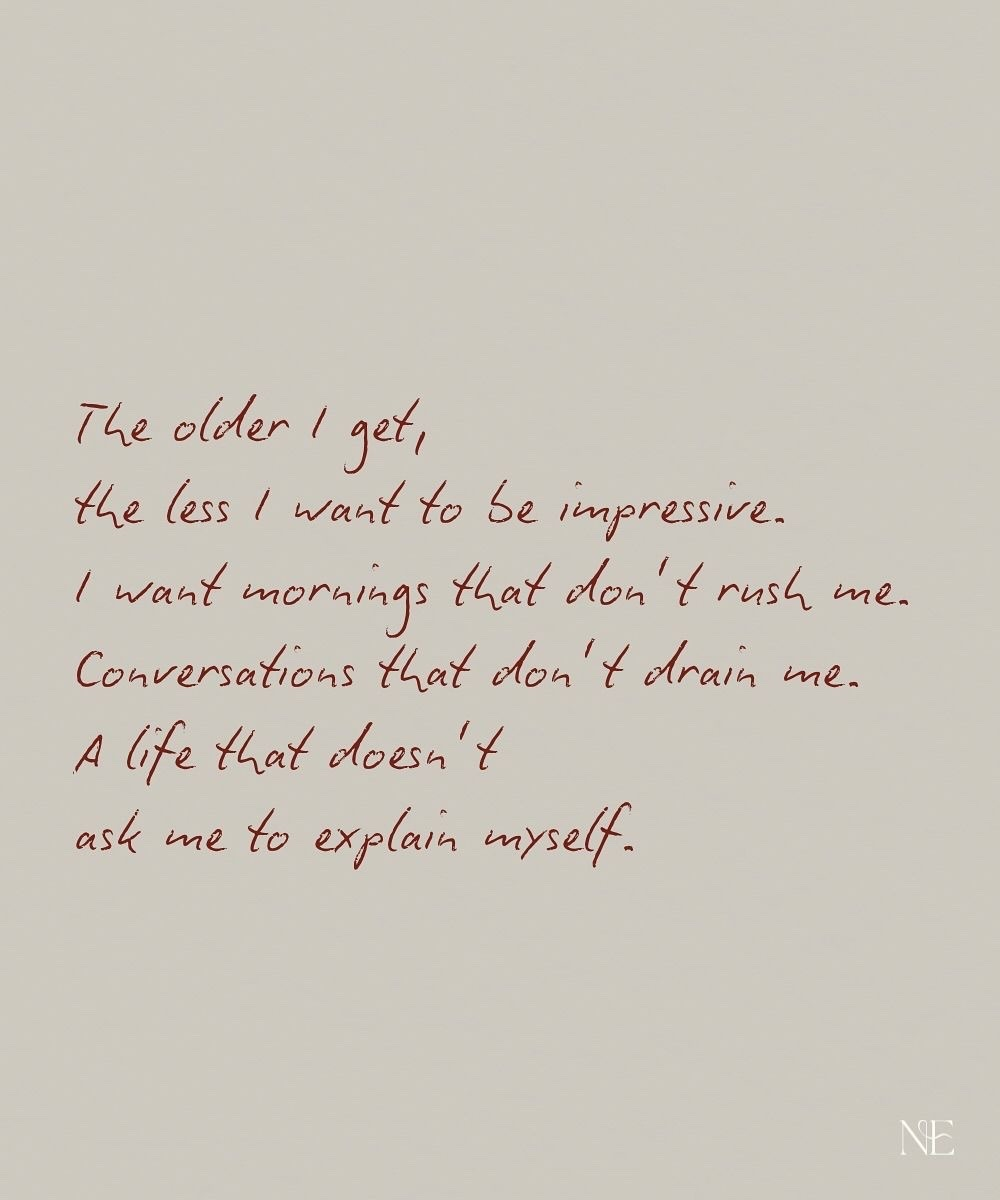
Be obsessed with your own life
Be obsessed with your own life - by hasif 💌
This isn’t just about choosing to focus on your own happiness or goals in a selfish way. No, being obsessed with your life is a radical act of self-respect and personal ownership. It’s a choice to break free from the constant noise, to turn off the distractions, and to commit to the deep work of understanding and shaping the life that only you can live. It’s about returning home to yourself in a world that’s constantly trying to take you elsewhere.
But what does it mean to be obsessed with your own life? Is it vanity? Is it narcissism? No. It’s the opposite; it’s a recognition that your time, your energy, your thoughts, and your decisions are valuable. It’s a commitment to yourself, to your personal growth, to your values, and to living intentionally, no matter what the world around you says.
2026-04-18
Is Los Angeles the Status Anxiety Capital of the World?
Is Los Angeles the Status Anxiety Capital of the World?
For some strange reason this reminded me of living in Bengaluru. I guess that's because I haven't lived in LA 🙃. I guess FOMO and status anxiety is a fact of life wherever you go nowadays 🤷🏽♂️.
For your average status-conscious Angeleno, anxiety begins and ends with sleep. Sure, there are Oura rings—sleep trackers hidden in obtrusive pieces of jewelry. But Angelenos will spend hundreds of dollars more on Loftie sound machines, sleep masks from Violet Grey, and magnesium supplements -recommended by their most RFK Jr.–coded friends. Completely sober - 20- and 30-somethings are excusing themselves from dinner at Chateau Marmont at 9 p.m. so they can get to bed early. The status dinner is no longer about what you’re eating, but when. In Los Angeles, it’s perfectly acceptable to eat dinner out of a tin before the sun sets, standing alone in your high-contrast Calacatta kitchen.
The next jolt of panic comes with coffee. It’s wonderful to be greeted by name by one of the high-cheekboned baristas at Maru Coffee, on Hillhurst. But if you are truly somebody in Hollywood, you will be too important to waste 20 minutes driving to a coffee shop—not to mention the time it takes to find parking. Your house will be too high in the hills, and nobody wants to sit in bumper-to-bumper canyon traffic behind a Harvard-Westlake student who’s eating breakfast, texting, and shaving while driving to school. On the rare days you wake up feeling European and think, Let’s go to a coffee shop, you’ll remember that you might run into someone in line who needs something from you—a friend from USC film school who wants notes on their spec, or an ex-girlfriend who’s on her ninth step and is hoping to make amends. It’s much safer to invest thousands of dollars in a Jura coffee maker and source beans from the Gorigesha Forest. If you’re truly somebody, your personal chef will top the coffee with raw milk before your assistant—who was up hours before you—hands it to you as you get into your Escalade mobile office, complete with first-class seats, Wi-Fi, and a 43-inch flat-screen TV.
2026-04-17
Mostpeopleslop
In 2006, Joe Sugarman published a book called The Adweek Copywriting Handbook - and an axiom stuck...
"The sole purpose of the first sentence in an advertisement is to get you to read the second sentence."
That line, more or less, explains how social media turned into a pile of shit.
Sugarman's advice became the core system prompt for 300,000 tech assholes on Twitter. They've run it through algorithm after algorithm and produced the most soul destroying rhetorical tic of the 2020s. I'm talking about "Mostpeopleslop."
I'll give the format its due: it works // performs. And the reason why is simple. "Most people" is a tribal signal - when you read "most people don't know about this," your brain does a quick calculation: Am I most people? Do I want to be most people? No? Then I better keep reading, so I can be the Holy Exception. But you're not actually learning fucking anything. You're being told you're special for having stopped to read, and the poster is offering you membership in an in-group, and the price of admission is a like, a retweet, any scrap of engagement. It's a scarcity play - people pay more attention to shit that feels exclusive.
"Most people don't know this" is exactly that.
Mostpeopleslop has metastasized because Twitter started rewarding engagement bait at the same time the creator economy started demanding you post all day // every day. If you're a tech influencer in 2026, you probably post 10 to 20 times a day, maybe more - this is what the gurus tell you to do. You need formats you can crank out fast that reliably get impressions, and "most people" threads do exactly that. There's no research required, and no original data - you barely need an opinion. You could generate these in your sleep, and thanks to OpenClaw some of these guys clearly do...
And it trains audiences to value framing over substance - if you read enough "most people" posts, you start evaluating ideas based on how they're packaged rather than whether they're true. A well-formatted "most people" thread with a mediocre idea will outperform a useful post that doesn't use the formula, and so yes the medium becomes the message, but the message is: style points matter more than being right or even being valuable in the first place.
2026-04-16
“Beef,” “The Drama,” and the New Marriage Plot | The New Yorker
Transcript: Critics at Large | The New Yorker - “Beef,” “The Drama,” and the New Marriage Plot
This is a wide-ranging podcast covering a lot of pop culture themes around relationships. But some quotes about marriage really stuck with me.
We're gonna be talking about several other texts, and we're gonna be talking in general about modern attitudes towards this very old institution. As we've said, it's kind of at an inflection point right now. Statistically, marriage rates are hovering around an all time low. And at the same time, people are trying to find new approaches to make marriage work. I mean, open marriages, polyamory, all of these things are feeling increasingly mainstream.
And my question for us is, at a time when relationships are more flexible than ever, what do we as a culture want marriage to mean?
Shout out to the long nineteenth century for this idea that marriage is not just a pact between 2 families and mutually advantageous decision made to further the line, but also that people are supposed to find love and romance and sexual fulfillment all wrapped up into this economic bundle with marriage. And as my support, I have on my lap 2 of my favorite friends, Madame Bovary by Gustave Flaubert and Parallel Lives, Phyllis Rose's wonderful study of 5 Victorian marriages.
The argument that Phyllis Rose is making is that marriage is a political experience, and it's the primary political experience that most people will have. It is about balancing of power. It is, of course, about power between genders, but it's about the the family and the marriage as a body politic in which two people are jockeying and negotiating. And things are frankly set up to not work more than they're set up to work.
I think we have this kind of fantasy idea of marriage as a time where everyone knew their place.The man was the center, and the woman's job was to just help the man fulfill whatever had to be done. And 1 thing that I love about the book Parallel Lives is that it shows us that that was really never satisfying for anyone. And I think that a lot of these ideas that we have now about freedom, personal freedom, sexual freedom, we're trying to reconcile them with marriage. And I think we're in a place where we're trying to make marriage seem more like a positive choice, rather than an obvious obligation. That we're doing this because the love is so great, because we can, envision the rest of our lives together, because it's this great mark of affirmation and faith in another person and also in yourself that you're gonna be the kind of person to hold this down.
And so in a way, it's a fascinating fiction that those who get married subscribe to hoping that the fiction becomes true. Phyllis Rose has a great line about reading marriage like you can read a novel. And I think that's true in a lot of these cases too, that life is a kind of fiction writing. Yeah. You are making it up as you go along, and who you are at the start of a marriage is not gonna be who you are at the middle and who you are at the end, and yet that keeps coming like such a rude shock to us. It's such a rude shock Yeah. That we get great literature, movies, TV shows, albums Yeah. From the shock of discovering that the other person is not who you thought they were and that you're not who you thought you were either.
I mean, for me, the great passage, the great moment in Madame Bovary is the opera, where, you know, Emma goes to the opera and she's like reawakened by the opera, sees Leon, the the sort of romantic rival of her husband, is like, you know what? I have to have an affair. You know? That romance is like art in that it has moments of cathartic learning. And if we're supposed to do that at the same time as we're in a contract, that's a lot of weight for any one institution, personal, privately, publicly, aesthetically, to bear.
2026-04-15
Shitty Flow and Zombie Flow
Wu says it's a mistake to attribute the regretted hours of scrolling to addiction or a failure of self-control. Rather, the user is falling into "passive flow," a condition arising from three factors:
I. Engagement without a clear goal;
II. A loss of self-awareness – of your body and your mental state;
III. Losing track of time.
I instantly recognize II. and III. – they're the hallmarks of the flow states that abstract me away from my own pain when I'm working. The big difference here is I. – I go to work with the clearest of goals, while "passive flow" is undirected (Thompson also cites psychologist Paul Bloom, who calls the scroll-trance "shitty flow." In shitty flow, you lose track of the world and its sensations – but in a way that you later regret.)
Thompson has his own name for this phenomenon of algorithmically induced, regret-inducing flow: he calls it "zombie flow." It's flow that "recapitulates the goal of flow while evacuating the purpose."
Zombie flow is "progress without pleasure" – it's frictionless, and so it gives us nothing except that sense of the world going away, and when it stops, the world is still there. The trick is to find a way of compartmentalizing that rewards attention with some kind of productive residue that you can look back on with pride and pleasure.
Books on Loneliness
Why loneliness, a recurring theme in literature, is difficult to comprehend
Books covered:
- The Lonely City by Olivia Laing
- The Loneliness of Sonia and Sunny by Kiran Desai
- Eleanor Oliphant Is Completely Fine by Gail Honeyman
The philosophical and personal narrative by British author Olivia Laing in The Lonely City: Adventures in the Art of Being Alone draws from the time she lived in New York. She writes, “Loneliness is difficult to confess; difficult too to categorise. Like depression, a state with which it often intersects, it can run deep in the fabric of a person.” We immediately get a sense of what to expect — an analysis of where loneliness stems from and its consequences, which linger in one’s mental health and very existence.
Kiran Desai’s The Loneliness of Sonia and Sunny explores the many layers of loneliness through fictional characters. The Booker-shortlisted novel traces the journeys of two individuals, Sonia and Sunny, negotiating distance, displacement, and belonging. Yet, this is not an entirely bleak story. Desai, who won the Man Booker Prize for The Inheritance of Loss, weaves in moments of hope as her character Sonia embarks on a path of self-reflection and discovery.
While some narratives trace loneliness with philosophical distance, others plunge into its most unsettling depths, as Gail Honeyman does in Eleanor Oliphant Is Completely Fine.
Loneliness is not always contemplative — sometimes it is isolating, corrosive, and dangerously silent. The novel begins on a bleak note. Eleanor Oliphant, a socially awkward and isolated woman living in Glasgow and working a routine office job, insists she is “completely fine.”
Yet beneath the rigid routines and solitary weekends lies a deep, unaddressed loneliness. Over time, she slowly finds her footing. As the author reminds us, “It is never too late, for any of us.” It is a poignant and joyful message.
The Other Bennett Sister
The Other Bennet Sister TV review — a sweet-hearted sideways take on Pride and Prejudice
The Other Bennet Sister offers up the legendary romance of Pride and Prejudice through the eyes of a peripheral character. Indeed, it largely dispenses with the events of Austen’s most famous novel by the end of the second episode, when it catapults off into Mary’s new life in London, away from the domineering and casually cruel and narcissistic Mrs Bennet (a very good Ruth Jones). She is frequently nudged in the direction of suitors, through the not-so-subtle machinations of her mother and the more heartfelt guidance of her aunt, Mrs Gardiner (Indira Varma), but, in this very contemporary tale, Mary must discover her true value for herself.
It all works remarkably well. The half-hour episodes are neat and pithy, suggesting a confidence with both sets of source material. It is light and fun, with a lot of heart, basking in the warmth of its own candlelit glow.
I bingewatched this show in a couple of sitting and absolutely loved it!
2026-04-13
Sometimes powerful people just do dumb shit
Sometimes powerful people just do dumb shit
Why do people resist the boring read? Melvin Lerner had a theory. He published a book in 1980 called The Belief in a Just World, and his argument was that most of us walk around with a bone-deep need to believe that people Get What They Deserve. If someone is rich, they must be smart. If they’re smart, their decisions must make sense. And if their decisions look dumb, well, you must be the one who’s missing something. It’s a warm blanket of a worldview. It just doesn’t survive contact with reality.
There’s something else going on, too, and it’s less intellectual // more animal. We see patterns everywhere. We see them when they’re not there. Kahneman built half his career on this - we are so desperate to find signal in the noise that we’ll construct entire narratives out of nothing, and a narrative where the powerful guy is playing 12 moves ahead is just a better story than one where he fucked up because that’s what people do.
Ube is the next matcha
The next matcha: coffee chains bet on ube’s viral appeal
Fun fact, I had ube ice cream at an NYC outlet in Chinatown like several years ago. Then, I found it in a late-night beverage truck in Bengaluru's HSR neighborhood a year ago.
UK café chains are betting on ube, the vibrant purple yam native to the Philippines, to replicate the viral success of matcha among younger, higher-spending consumers.
The ingredient’s purple hue has been critical to its adoption by mainstream brands seeking social media success, according to Kiti Soininen, a food and drink analyst at Mintel. “The unusual and vibrant colour is at the heart of it, just as it was in helping matcha and Dubai chocolate go viral,” she said.
The push into ube comes as brands are “constantly looking for the next matcha,” said Lisa Harris, co-founder of food consultancy Harris and Hayes. The Japanese green-tea-based drink has grown in popularity globally over the past decade but rapid increases in consumption and a bad harvest last year are putting pressure on supply and driving up prices.
The contradictions of wokeness
Full transcript: https://www.debugjois.dev/apps/transcript-reader#t=9696b6681f98cbd9
The tweet length answer is that these periods of awokening happen when there's a big crisis for elites, where they are expecting a certain life and it seems like they won't be able to live that life. one thread that cuts across all four awokenings is that they tend to occur during these periods of elite overproduction. So elite overproduction is a term that's taken from sociologist Jack Goldstone and historian Peter Turchin. And it refers to a condition where society is producing more people that have a reasonable expectation to be elites, then we have the capacity to actually give them the elite lifestyles and positions that they're expecting. So you have growing numbers of people who did everything right.
They got good grades, they went to college, they went to the right colleges, they studied the right majors. And they're expecting six figure salaries and to be able to have a house and to get married and settle down and have kids and a standard of living that's close to or better than what their parents experienced. And all of a sudden they're not able to do any of that. When you have growing numbers of people in that kind of a condition, what they tend to do is indict the social order that they think failed them and try to tear down some of the existing elites to make space for people like themselves. So that's at their core, what I argue is happening in awokenings.
The 2 factors that cut across all Awokenings are the elite overproduction and this other factor, popular immiseration. So elite overproduction, one reason why that's not enough to predict awokenings, why it's not sufficient, is because often when elites are having a tough time, it's hard to get anyone to care. And that's because there's this phenomenon where the fortunes of elites and non elites tend to operate countercyclically. When elites are having a tough time, it's hard to get anyone to care. No one's breaking out a tiny violin and going, Oh, poor elite guy.
He has to live a normal life and get a normal job like everyone else. Oh, let me play you a Sam song, right? So if times are pretty good for everyone else but bad for elites, no one cares. But there are these moments when the trajectories get collapsed, when things have been kind of bad and growing worse for ordinary people for a while, and all of a sudden they're bad for a lot of elites too, those are the moments when awoken things happen. Because the frustrated elite aspirants not only have a motive, but they also have a means to really mess with the system because there's this huge base of other people in society who are also really frustrated with the way things are going, who also have a bone to pick with the people who are kind of running the show.
And so they have more leverage. These frustrated elite aspirants have more leverage over the system than they otherwise might.
Host
Do you think the New York Times doesn't give a shit about George Floyd until he's been killed by the state? Or is it that the audience won't pay attention until that's the case?
Guest
I think it's kind of both. And part of the reason it's both, actually, I talk about this a bit in the book is that the people who produce and consume these narratives are increasingly the same people. It's the same slice of society that's producing almost all of this work in the symbolic professions. And they're almost the exact same as the audience that's consuming them in terms of where they live, the professions they work in, what their values are, the kinds of educational background they have, and so on. It's this really incestuous relationship increasingly between writers and audiences where they're virtually identical.
So I think it's the case that a lot of the writers don't really, and editors and stuff, don't really have their finger on the pulse of normies. But I think it's also true that the audience of The New York Times doesn't particularly care about normies and their problems either.
But that said, I also tried I think a lot of the anti woke kind of culture warriors are going to have a tough time really mobilizing the book the way they might hope, both because it has a lot of very critical things to say about the anti woke kind of people and the game that they're playing as well. I apply a very symmetrical lens to understanding them and their behaviors and actions. And the book also, the reality is a lot of work like in queer theory or critical race theory or feminist standpoint epistemology or postcolonial theory, these modes of scholarship deeply inform my own thinking, including on these questions about power and ideology and how they relate to each other. In a deep sense, what the book is doing is taking the arguments from these literatures to what I perceive to be their logical conclusions, which should lead us to ask of our own ostensibly emancipatory ideologies whether or not they might also reflect our class interests, whether or not they actually represent the values and interests of the people that we're trying to help. And whether or not, like like there's no reason to think that our own belief systems are exempt in a lot of these other related literatures and not to villainize them or mock them or demean them, but in fact, to show how they can be valuable.
And so in this and a lot of other ways, I think the book is not easily digestible into the culture wars and the ways that people might hope.
2026-04-12
The Art of Pooping
Podcast #1,112: You’ve Been Pooping Wrong — Here’s How to Do It Better | The Art of Manliness #bowel
Full transcript: The Art of Manliness - You’ve Been Pooping Wrong — Here’s How to Do It Better
Harvard gastroenterologist Dr. Trisha Pasricha is the author of You've Been Pooping All Wrong: How to Make Your Bowel Movements a Joy. Today on the show, Trisha and I have a fun and frank conversation about the art and science of bowel movements, including the color of healthy stools, how often you should be pooping, if laxatives are safe to use, the food to eat that's even better than prunes for getting things going, why you feel the urge to go poop at Barnes and Noble, the wonders of the bidet, the danger of using your smartphone on the toilet, how to get more comfortable pooping in a public restroom, and more.
I had not realised kiwis (which are a part of my daily diet here) have some great benefits to pooping.
But I will say there are a lot of ways that you can improve your bowel habits, become less constipated just by changing things about what you're eating and what you're doing, and even the position of how you're sitting on the toilet. I mean, it's very common that people don't wanna take medicines, but you can take things as natural as, like, kiwis. Right? Like in our grandparents' times, people were taking prunes, and prunes are incredibly effective.
But I have never successfully convinced a college student to take prunes. It's like 1 of those things that people just don't reach for anymore these days. But kiwis have been shown in multiple randomized controlled trials, 2 kiwis a day, that they are as effective as prunes, but they also don't cause bloating. Like a lot of these, like, fiber supplements and prunes can cause, kiwis don't seem to do that. So it's a pretty simple fix that's relatively effective, all things considered.
And and it's not really a laxative. It's actually just something that's high fiber, got a lot of nutrients, and is good for you in other ways.
Some of the explanations are really good and clear
Host
Gotcha. So what what happens to our stool whenever we get diarrheas? Why does the body decide this stuff needs to be liquid and get out fast? Like, what's happening there?
Guest
Yeah. There's lots of different causes. But in terms of your anatomy, your small bowel, which is that first part of the tube after your stomach, the main point of your small bowel is to absorb all the nutrients. And it's sucking out everything that it wants and breaking it down. And then the stuff that it can't break down, which is usually like the fiber, which we actually don't possess the enzymes to break down.
It makes its way to our microbiome in our colon. Well, the colon has several jobs. 1 of them is to suck water out of the stool as it passes through. And stool passes a little bit more slowly through the colon, so your colon has a lot of time to get that water up. But if something happens that triggers that poop to move forward, and sometimes it's stress, stress can cause our colon to suddenly start to contract.
That means we haven't had time to remove and absorb all the water out of it yet, so it's gonna gush out like diarrhea when we're stressed. Spicy food does that. Spicy food sends this signal down to say, okay. Evacuate everything we have. That too will make whatever comes out to be a little bit fiery, a little uncomfortable, and it'll also be pretty liquidy.
And then there's other things like infections or just depending on how things are going with with other aspects of your life, travel and exercise, those things can also help speed things up. But before, you've really had a chance to absorb all the water.
and this one about constipation
Host
Gotcha. And constipation is just the reverse. It's been in the colon too long, so all that water's been sucked out.
Guest
Yeah. Exactly. And there's a ton of different reasons why we things slow down and why we can get constipated. And and and you're right. The longer we sit there, the longer that stool is just your colon is gonna keep doing its job, and it's gonna keep making it harder and harder, which is why I sometimes think the most important thing people can do who are constipated is just as soon as they hear that call, feel that urge, respond because it's not gonna be the same poop later on.
Host
What causes constipation? You said there's lots of potential sources.
Guest
Yeah. Well, when someone comes into my clinic and they have constipation, I I try to explain the way the colon works in terms of trying to get toothpaste out of a toothpaste tube. So sometimes the issue is that we're not squeezing that toothpaste tube. And that means that maybe there's something that's stopping the colon from contracting so much. We need to do that.
We need to generate pressure in order to push the stool outwards. And maybe the problem is actually not that we're not squeezing the tube, but that the toothpaste itself is rock solid. And sometimes that happens because maybe we're not getting enough fiber. Maybe we're not drinking enough. Maybe there's something else that's making that stool really, really hard.
But then the third and I think most underappreciated part of the problem is that, yeah, we're squeezing hard enough. The toothpaste is super soft, but we forget to take the cap off the toothpaste tube. And then we're just pressing up against this pelvic floor that is not cooperating. And that is very common. That happens to about 1 in 3 people who have constipation and who have tried different laxatives and different things and they failed.
And basically what that means is that our pelvic floor, which is this set of more than a dozen muscles sitting there at the bottom of our rectums, and they need to coordinate in this really highly orchestrated dance. Some need to contract at the right time, some need to relax. And for a lot of people, the sphincters that are supposed to be relaxing actually contract when we bear down. If you think about it, we're like generating all this pressure to try to push our poop out, and people's sphincters contract. And and that's very paradoxical.
It's not supposed to do that. So sometimes when you've tried everything, the most obvious answer is actually something that doesn't involve anything related to your colon, but actually it's all the muscles in your pelvis that's the problem.
2026-04-10
Barista Judgemental Glare
Brooklyn Coffee Shop Episode 55: Kumail Nanjiani, Barista Training Expert 🪪☕️ - YouTube
I was at a coffee shop in Berlin today and the barista messed up my order by pouring somebody else's order into my reusable cup and handing it to them. When I pointed it out to the barista, he had this look about him as if it was my fault, which reminded me of this episode of Brooklyn Coffee Shop.
The transcript is reproduced in full below.
Hey guys, it's that time of the year again. I'm here for your hipster barista assessment.
No one says hipster anymore.
You've passed the first test. Nobody says the h word anymore.
I'm sorry. Who are you?
How do you not remember me? I'm Kumail Nanjiani, h word barista expert.
Wow, your aura is like completely different this year. I didn't even recognize you.
Yeah, something seems off. You seem very emotionally regulated.
Oh yeah, I've been on a healing journey. I started therapy.
Therapy? I thought it was a requirement for all Brooklyn baristas to be chaotic and unhinged.
I've been avoiding therapy for years for my craft.
Yeah, that's a big update we're doing to 2026. Now, we want all baristas to go through therapy so that your rudeness comes from a place of creativity rather than trauma. As you know, you need a high score to keep operating a coffee shop in Brooklyn. First, let's see your judgmental glare.
Okay, it's a little dead behind the eyes. I need a bit more boredom, a little more disdain. Like, you looked at me and you already know I'm the problem. More like Mhm. Mhm. Judgmental glare 8 out of 10.
Not. Seriously,we're known in Brooklyn for our judgmental glare.
You were there for a moment.
We have at least 10,000 negative Google reviews about it.
You think 10,000's a lot? All right, let's talk about reading. What are we perusing these days?
Only books on Marxism and existential thought.
Marxism is so played out. It's so old. I mean, look at your mayor. My mom is into Marxism. She's got a little Marx bumper sticker on her Subaru. Now all the cool baristas have circled back around to loving capitalism.
But I spent my entire adult life blaming all my problems on capitalism.
I would shift that blame right over to taxes.
As a fourth generation Gatsby, I can do that.
That's right. Rich is cool again, guys.
All right, let's hear your self-sabotage initiatives to keep customers away.
We've been playing with insults. Usually three to four per customer.
Sometimes we post to our Instagram story that we're suddenly closing and then we stay here just so that we can turn people away.
We never have what people order even though it's on the menu.
Oh god.
When we're in a bad mood, we triple our prices and that is often.
You guys are nailing it right there. All right, let's talk about what are your milk options right now.
Oh, so today we have cacti, water, buffalo, avocado seed, and potato milk.
Trick question. We're all post milk now. You haven't heard of milk fatigue?
The milk is getting fatigued?
We are tired of milk.
No milk made in the house.
How can milk get tired? Milk don't be alive. We're now in our post milk era. I always knew this day would come.
Okay, I have tallied up your scores. You're a B+. Dang it.
I promise next year we'll be even more unapproachable.
Yeah, we'll go to therapy so we can weaponize wellness even more.
B+ is actually the highest score you can get.
I knew it.
We do that just to keep people grounded.
All right, you guys can attend my new workshop. It's called Healing for Baristas. How to calm yourself while flustering others. I will save you two spots
2026-04-09
Did Wokeness Leave Us Worse Off?
Opinion | Did Wokeness Leave Us Worse Off? #linguistics
Spiegelman: “Woke” obviously has had a lot of different transitions as a word, and who uses it and how, and to mean what. And I would say that it seemed like a positive thing to be woke five years ago. And now it doesn’t feel that way anymore. Have you noticed a shift, and where are you noticing it?
Colyar: Yeah, when I’m trying to describe my politics to people, I often say that I have some “anti-woke” sensibilities. And by saying that, I think what I’m often trying to do is distance myself from the woke of five years ago — this way too earnest, super p.c. kind of cringe, resistance-y culture, whose politics I mostly support, but the way that it’s carried out is cringe to me. Yeah, I think “cringe” is the best word.
Spiegelman: What about you, Amina?
Sow: Yeah, “cringe” is a really good word. Thank you to the young people for that one. I do think that language moves very fast. And I think that sometimes, too, when I hear people use certain words, all it does is carbon-date them for me.
So, if somebody says “p.c.,” I’m like, got it. Like, you’re a 1990 and before person. We love that last century, you know? And if you’re a different kind of person and you say “woke,” I’m like, great. You’re a new century person. But do the words mean the same things to us? And that’s not always apparent.
What you were saying about the Biden years, I think the reason it feels like we’re having this kind of backlash to this culture right now is because of the institutionalization of it in our workplaces and on campuses. And I don’t think even good liberal people feel like the antiracist training that they’re doing in their office is helping anyone. Even people who respect people’s pronouns and believe in nonbinary identity or whatever, I don’t think that they think that putting it in their signature is helping anyone, and I think they’re rolling their eyes and laughing about it in private.
And so, when I find this wanton cruelty being the driving force — because, again, everything exists in a context — I think that what I find particularly grating about the “I want to be able to use the R-word, I want to call women [expletive], and I want to call people the N-word,” you know, whatever it is, I’m like, why do you want to do that? Why is it so important to you? What is so important about being able to say that to someone who is telling you they don’t want to hear that?
…
Colyar: But I will say, I do think that most people are willing to be polite, but so much of this has gotten so fraught, on the example of pronouns, because people do not allow people to learn. People do not give them the grace to try and figure out how to get these things right. I mean, people are militant about this stuff and will bite your head off, bite their professor’s head off over a misgendering situation, and that makes it really hard to move forward.
This one made me LOL, iykyk 😂
Sow: I want to ban straight people using “partner” when they mean husband or wife. I’m just like, I don’t like this signaling of your politics. I really hate it, because it’s very sinister, actually.
Colyar: They’re hiding. It’s like they’re doing some queer for clout ——
Sow: I’m like, you’re literally participating in the most heteronormative institution a person could participate in. And you don’t get to rebrand it.
I do wanna say though, participation is not necessarily an endorsement.
The Women Who Love the Manosphere
The Women Who Love the Manosphere - WSJ
Love the phrase manosphere-adjacent to describe Huberman (accurate imo)
Then there are others she loves that are better described as manosphere-adjacent: Andrew Huberman, the brawny neuroscientist and podcaster with a cult following, is a source Craig turns to for wellness advice. Following Huberman’s self-described “protocols,” Craig adheres to a rigid sleep schedule and workout routine, and never skips her morning dose of cryotherapy, collagen supplementation and sunlight exposure. She cites his guidance on her TikTok page, where she promotes a disciplinarian approach to physical fitness.
2026-04-08
Friendship Breakups
Why do friendship breakups hurt so much? | Dazed
Friendship breakups are incredibly common – studies show that around 70 per cent of close friendships end after seven years – and yet there is little guidance available on how to navigate them. It’s a stark contrast to the way breakdowns of romantic relationships are treated in culture; there are innumerable books, films, and TV shows dedicated to unpacking the pain of heartbreak (there’s probably a Sex and the City episode for every flavour of dating turmoil imaginable).
“Romantic relationships have long been a central focus of psychological research, popular culture, counselling, and self-help literature; they are widely recognised as a life transition with established language, rituals – such as break-up conversations – and social norms around grieving and recovery,” Dr Jenny van Hooff, a sociologist at Manchester Metropolitan University, tells Dazed. “By contrast, friendship breakups are often minimised or dismissed in both academic and everyday discourse, which means there is less culturally sanctioned language and fewer models for grieving them. As a result, people may struggle to validate their own pain.”
new word unlocked - amatonormative
Despite our culture being amatonormative – that is, romantic-relationship-centric – our friendships are central to our lives. “Close friends often provide ongoing support, shared history, mutual trust, identity affirmation and a sense of belonging,” says Dr van Hooff. “When a friendship ends, it is not only the loss of contact with another person that hurts, but also the loss of routines, companionship and emotional scaffolding that the relationship provided.”
Capitalism is Obsessed With Death
Is Employment Making You Ugly?
It's a quote of a quote that I found in one of my favorite newsletters.
RELATED: I wanted to fit this quote from Byung-Chul Han’s Capitalism and the Death Drive in my Guardian article on cadaver fat fillers, but I couldn’t, so I’ll just leave it here:
“Capitalism is obsessed with death … Performance zombies, fitness zombies, and Botox zombies: these are manifestations of undead life. The undead lack any vitality … Capitalism’s striving for life without death creates the necropolis — an antiseptic space of death, cleansed of human sounds and smells. [ED NOTE: I would add textures to this list!] Life processes are transformed into mechanical processes. The total adaptation of human life to mere functionality is already a culture of death. As a consequence of the performance principle, the human being ever more closely approximates a machine, and becomes alienated from itself.”
Great Books in 52 Weeks
How to Read the Great Books in 52 Weeks - by Ted Gioia
The original substack containing the program is behind a paywall. At some point I considered subscribing just to unlock that one post. Maybe some day!
A few weeks ago, reader Cheryl Drury reached out to me. She had been inspired by my 52-week humanities program. Not only had she completed the course, but documented her progress on a podcast.
2026-04-07
The Hacker News Tarpit
I like the formulation of sites like HN being a Schelling point problem. The secret sauce is not in the technology or the software at all.
A link aggregator is only as good as its community, and the community is only as good as the people in it, and the people are only there because the other people are there. This is a Schelling point problem; everybody needs to coordinate on the same place, and which place they coordinate on is partly arbitrary, and once they've coordinated it is very expensive to move.
There's a bar in your city where all the interesting people go on Thursday nights. The bar is not special. The drinks are mediocre, the lighting is bad, the bathrooms are questionable. But interesting people go there, which makes it interesting, which makes more interesting people go there. If you open an identical bar across the street with better drinks and better bathrooms, nobody is going to switch, because the interesting people are at the other bar. They all know they're at the other bar. There is no mechanism for coordinated switching.
I think the vibe coding discourse has a hole in it, and the hole is shaped like the question: "what is software for?"
If software is a thing you build, then vibe coding changes everything. Anyone can build. We have democratized building. Congratulations to building.
But software is mostly a thing people use, and getting people to use things is not a building problem. It never was. The reason most software fails is not that it was too hard to code. The reason most software fails is that nobody wanted it, or everybody wanted it but was already using something else, or the right people wanted it but couldn't find it, or they found it but didn't trust it, or they trusted it but couldn't get their team to switch.
Hacker News works because Paul Graham had an audience before he had a product, Y Combinator had a network that seeded the community, and dang has been doing the same moderating job every single day for over a decade with what I can only describe as an unreasonable level of dedication. The whole thing has been accumulating social capital for almost twenty years...
I built a Hacker News clone in six hours. To me, it's perfect and for everyone else it's empty and those two facts are going to remain true forever. If that doesn't tell you something about what software is and isn't, I don't know what will.
The Ten Commandments of Mental Health
10 Commandments of Mental Health - by Josh Zlatkus
with a sidenote that this was published on April 1st.
- Give me structure, or give me death!
- Rather than diagnosis, accommodation, or medication, give me sleep, movement, and sunlight.
- The not-so-curious paradox is that I only seem to change when I must.
- Man shall not grow by insight alone.
- Everything you experience happens for a reason—usually an evolutionary one.
- If at first you don’t succeed, try giving up.
- Thou shalt not acquire meaning from comfort.
- Know thy self’s insignificance.
- I regret that I have but myself and my happiness to live for.
- Forgive them, Father: they know not how to live with abundance.
Why Gen Z is taking up boomer hobbies
Why Gen Z is taking up boomer hobbies
Some are taking up knitting or crochet. Others are growing flowers or going fishing. These days, such hobbies are no longer old-fashioned. For Gen Z has decided that the pastimes of pensioners are rather pleasing.
…
“Grannycore”—as youngsters call the trend—is not limited to entertainment. Gen Zers respect their elders’ taste in homeware and fashion (think florals and cardigans).
…
As one fan of the old-timey trend recently put it: “Grandmas were onto something.”
2026-04-06
Bait - TV series
Just bingewatched this, and loved it! The last time I really liked Riz Ahmed was in The Reluctant Fundamentalist (esp the Urdu monologue in the Last Speech scene). Have been a huge fan since then.
2026-04-05
Walter Benjamin Biography
Walter Benjamin — Peter E Gordon’s vivid pearl of a biography
“Just to sit once more on the terrace of a café and twiddle my thumbs,” wrote the great German-Jewish critic and philosopher Walter Benjamin to a friend in 1939, “that’s all I wish for.”
Kyla Scanlon
This prelude from Kyla Scanlon's latest newsletter took me completely by surprise. I have often wondered about (and occasionally been envious) how people like and others that I admire can be so prolific. And then you come across the flip side of it
I have to go on an elimination diet because my gut is eating itself and that apparently is also destroying my thyroid because I am not absorbing any nutrients. In order to address this, I have to stop eating wheat, dairy, corn, egg, tomato, peanuts, coffee, soy, cacao, sugar and manyotherthings (this is not like a juice cleanse or something fun, it’s something I have to do to stop my body from attacking itself). I have to write down what I do eat and how I am feeling and then evaluate from there as to what I can eat in the future.
If there was a quick fix - say an injection - I would try to take it. I don’t KNOW what’s happening to me, I just know that I got lots of vials of blood drawn and the miracle of modern science has informed me that some things are not going very well.
But, funnily enough, part of the problem is that I took shortcuts. I traveled 40 out of the 52 weeks last year (a lot for me) and some days, I would just subsist on granola bars and about 14 cups of coffee. I would also run and work a lot and sleep very little because I was totally and completely invincible. After all, I was an optimization machine.
And for a time, I sure was. But then, I wasn’t. Turns out, I wasn’t really optimizing anything, I just was avoiding what I actually should have been doing like sleeping. What I needed was to stop adding things and start figuring out what was making me sick. That's the opposite of what we've been sold.
From: The Ozempicization of Everything - by kyla scanlon #health #overwork
Anyway back to the focus on the newsletter
Naturally, industries have formed to monetize this nihlism through promising solutions. But the solutions never arrive, because the nihilism, the giving up, must persist in order for these products to survive. It’s a version of Ivan Illich’s Limits to Medicine, where he argues that the medical establishment itself produces illness by making people dependent on professional intervention rather than building health. That effect carries across all these optimization tools, creating dependency on the fix rather than addressing the cause. The optimization economy can't deliver control, because the desperation is the market condition, and the pursuit of control through optimization is itself a loss of control.
The shift from railways to peptides is the shift from “we built this for everyone” to “you can buy this for yourself.”
What we have is the Ozempic optimization of everything - Ozempicization, if you will. We have a suite of magic shots now in the form of peptides and everything else that address effort and discomfort and complexity. Everything can be optimized. Everything can be controlled.
It’s revealing that Silicon Valley’s word of the moment is ‘agency’ as it dresses up that desire for control. Optimization is the process, control is the desite, and agency is the branding. It’s not clear what agency means in startup land (similar to other words often used, like taste) but it does hint at someone who will force the universe to bend to their will, one way or another3.
and the article I logged just over a month ago (2 Mar) makes an appearance again! 😊
Cluely is a company that embraced this wholeheartedly, the final boss of the hustler economy. Their original ethos was cheating (they have since pivoted into AI notetaking) and they have raised millions and millions of dollars4. For them, “scamming” was being “agentic” which is indeed the “hottest commodity in Silicon Valley” as Sam Kriss wrote in his piece Child’s Play:
The future will belong to people with a very specific combination of personality traits and psychosexual neuroses. An AI might be able to code faster than you, but there is one advantage that humans still have. It’s called agency, or being highly agentic. The highly agentic are people who just do things.
And they are just doing things, driven by (understandable) fears of the permanent underclass and becoming useless in the age of AI. Apparently, the way that you avoid both of those is by “constantly chasing attention online.”
Then there is a whole section on The Manosphere which is too long to quote, but worth reading in full.
and this bit makes me feel called out 😂 (although tbf I am not monitoring the daily news or vibe-coded dashboards.)
We tend to seek control in every facet of our lives, including information consumption. Amanda Mull wrote a brilliant article about “monitoring the situation” - people (clearly, like me) who get glued to their screens trying to piece things together. And there is a lot to sort through: war, a government partially shut down, erratic fiscal policy, weak labor market, high prices, etc. It’s soothing to go to places like Twitter and read the OSINT feeds and to feel like you’re… informed. As Mull searingly writes:
If you can dial in your feeds’ algorithms just right, maybe you can bear a type of witness so complete it feels like participation, or maybe even control. After all, there’s decent evidence that the people launching the bombs are monitoring some of the same feeds you are.
2026-04-04
everything i read in february & march 2026
truer words were never spoken.
In the last few years, I’ve written thousands and thousands of words about the same idea: that reading more (books, magazines, and essays) will change your life for the better. It will satisfy you more than the slop that is, supposedly, more entertaining and fun to consume. It will draw you closer to other people, closer to the world. It will disturb your pre-established understanding of the world and offer a subtler, richer, deeper experience of reality.
Brooklyn Coffee Shop
I stumbled upon this series while bedrotting and recovering from a wisdom tooth surgery this week.
It's kinda hard to locate a sequential playlist of all the episodes in this series (there are like 60+ so far afaict), but this is the official Instagram account: Brooklyn Coffee Shop (@bkcoffeeshop) • Instagram photos and videos
This article I found describes the show very well: Turmeric Lattes & Millennial Marxism: In Conversation With Pooja Tripathi Of Brooklyn Coffee Shop | Homegrown
Your coffee order says everything about who you are. Plain black without sugar screams old-school, efficient, and honestly, "Who hurt you?" The cappuccino with foam art is for the basic bitches (sorry!) and and the iced matcha latte with dairy-free milk and a scientific customisation speaks to a very Gen Z-coded sense of hyper-individualism. Cafés today have evolved into the wild wild West of curated identity — shaped by micro-trends and cultural semiotics, where taste is both aesthetic and ideology. These theatres of self-performance and the weird little niches they are comprised of, become the playground of the beloved Instagram & TikTok series Brooklyn Coffee Shop.
Created by Pooja Tripathi, a New York-based writer, producer, and performer, Brooklyn Coffee Shop is a satirical series that distills the internet’s most peculiar subcultures into tightly composed, hyperreal vignettes set in a fictional café. The series constructs a microcosm of the modern urban life in a digital age where aesthetics, belief systems, and social capital collide. With sharp worldbuilding, deadpan humour, and a precise understanding of internet folklore, it paints an incisive and chaotic picture of the zeitgeist.
The series delivers some heavy critique but through the lighthearted premise of sketches. Its tone comes from absurd comedies that Pooja has always been a huge fan of. She counts 'Portlandia' and Lena Dunham’s 'Girls' as formative influences, both of which combine observational wit with an irreverent lens on urban pretentiousness. Add 'My Favorite Shapes' and 'Fantasmas' by Julio Torres to the mix , and you begin to understand the show’s DNA. “Comedy always has a kernel of truth at the core,” Pooja notes. “Even if it’s exaggerated and heightened for a sketch, I think that core truth is what hooks people.”
Another article: The viral internet coffee shop where every order is a social critique | Vogue India
Forget about your basic black coffees and cappuccinos. Brooklyn Coffee Shop only serves intricate drinks with substitute milks: raw-avocado-pit, barley, flax, melon-seed, acorn and, of course, breast milk. (If their in-house goat Felicia isn’t too emotionally exhausted, goat milk is also an option.) Being a customer here is harrowing, but to be a barista, there is only one requirement: to have mastered “the glare of disgust”.
In 2021, Tripathi created her first skit set in a coffee shop. Shot in front of a green screen, she played both barista and customer. The video recognised something crucial: in cities around the world, coffee is not just a beverage but also a status symbol—each coffee order is a performance. Her friend, cinematographer Eyal Cohen, suggested they turn it into a professionally shot series and the switch was made from a green screen to Larry’s Cà Phê in Williamsburg. Since then, Tripathi confesses, she is always thinking about BCS.
I would love it if somebody already created a list of all the books featured on it.