Daily log archive for Jan 2026. Go to the current daily log, or browse the archive index.
Subscribe to the weekly email digest. Check sample email out.
2026-01-30
Grindcore
Grindcore is the new hustle culture #technology #work #culture
In Silicon Valley, long hours have fused with a monastic male wellness aesthetic
But the “grindcore” lifestyle has taken on fresh intensity against the backdrop of a frantic San Francisco AI arms race, and growing anxiety among AI labs that a rival — or worse, China — might be the first to achieve AI supremacy.
It is not just tech bosses pushing the trend. Founders and engineers are jumping at the chance to broadcast how hard they are toiling. In September, dozens took to social media to announce their participation in what was dubbed the “great lock-in” of 2025 — in other words, spending the final three months of the year rejecting work-life balance to produce their most valuable labour yet.
Intriguingly for a world known for its badly dressed nerds, this narrative has been fused with a monastic male wellness aesthetic.
Instead of downtime enjoying the Californian sun and surf, grindcore adherents should fill the remainder of their day with workouts, Paleo diets and Chinese peptides. Many are embracing “manosphere” culture propagated by Maga-adjacent influencers that preaches antifeminism ideals and physiognomy.
“The current vibe is no drinking, no drugs, 9-9-6 [working from 9am to 9pm, six days a week], lift heavy, run far, marry early, track sleep, eat steak and eggs,” Daksh Gupta, the 23-year-old co-founder of an AI start-up, told the San Francisco Standard recently.
2026-01-28
The Computational Case for Hypocrisy
The Computational Case for Hypocrisy - by Aditya Kulkarni #evo-psych #evolution #psychology
Training massive AI models like Gemini or ChatGPT is an exercise in brute force. It costs hundreds of millions of dollars and requires server farms the size of industrial parks. The result of this process is a “Base Model”—a frozen, complex network of mathematical weights that “knows” how to predict the next word in a sentence.
Humans have an equivalent “Base Model,” too.
It resides in evolutionarily older decision systems that operate largely outside conscious processes. Just like an LLM, this biological base model was pre-trained on a massive dataset: millions of years of evolutionary trial and error. Its weights are heavily optimized for a specific set of survival outputs: Consume high calories. Pursue mating opportunities. Dominate rivals.
As AI researchers have discovered, it is almost impossible to subtract from a neural network. If you take a fully trained neural network and try to force it to “unlearn” a core concept—or aggressively “retrain” it on new, contradictory data—you trigger a phenomenon known as Catastrophic Forgetting. Because knowledge in a neural network is distributed across billions of connections, you cannot simply isolate and delete a specific bad behavior without unraveling the rest of the system. If you force the model to unlearn “aggression,” you might accidentally degrade its ability to navigate terrain or recognize faces.
When AI researchers want to “fine-tune” an AI model to learn a new, specific behavior, they often use a technique called Low-Rank Adaptation (LoRA).
Instead of melting down an AI model’s neural weights and recasting them, researchers have discovered that simply attaching a small, thin layer of new parameters on top of the model allows you to change its behavior. It is a lightweight mask that sits over the heavy, deep machinery. This “Adapter Layer” intercepts the output of the frozen model and steers it in a new direction.
To change the behavior, you don’t touch the foundation. You build an addition.
Evolution likely arrived at the same architecture…
Instead, evolution built a “LoRA Adapter”—the neocortical Press Secretary. This adapter doesn’t stop the impulse from firing; it layers a transparency over it. It translates the raw signal—“I want to eat this cake”—into the socially acceptable output: “I am carbo-loading for a run.”
The Press Secretary evolved because “re-training” the amygdala is practically impossible. It would be like reshooting an entire movie just to translate the dialogue into French. You don’t fly the actors back to the set; you just add dubbed audio. Hypocrisy is the adapter layer that allows a Paleolithic brain to operate in our modern civilization.
we've created a society where artists can't make any money
we've created a society where artists can't make any money #writing
I began to realize that many of the essays I read—in prestigious and well-know. magazines—were edited and written and fact-checked by people barely able to make a living from their work. Many magazines were labors of love; others were underwritten by a generous donor or a government grant. (The London Review of Books, I learned, operates at a loss: £27 million since the magazine was founded. It’s thanks to a former editor’s family trust that they’re able to continue publishing.)
The writer W. David Marx’s latest book, Blank Space: A Cultural History of the Twenty-First Century (November 2025), argues that this narrative of decline is true—that art and culture are less innovative than before. I wanted to review Blank Space because Marx’s first two books (Ametora and Status and Culture) were exceptionally good…and because I wanted to understand if I agreed with him. Were things really getting worse? And did the question of money—how little of it there seemed to be, how precarious cultural labor was—have something to do with it?
You can read my review essay below, or on Asterisk Magazine’s elegantly designed website
2026-01-27
Why software work estimations are hard
How I estimate work as a staff software engineer #software #estimates
Just putting it here so that the next time somebody comes along wondering about this, I can point them here.
I’m also going to concede that sometimes you can accurately estimate software work, when that work is very well-understood and very small in scope. For instance, if I know it takes half an hour to deploy a service1, and I’m being asked to update the text in a link, I can accurately estimate the work at something like 45 minutes: five minutes to push the change up, ten minutes to wait for CI, thirty minutes to deploy.
For most of us, the majority of software work is not like this. We work on poorly-understood systems and cannot predict exactly what must be done in advance. Most programming in large systems is research: identifying prior art, mapping out enough of the system to understand the effects of changes, and so on. Even for fairly small changes, we simply do not know what’s involved in making the change until we go and look.
The pro-estimation dogma says that these questions ought to be answered during the planning process, so that each individual piece of work being discussed is scoped small enough to be accurately estimated. I’m not impressed by this answer. It seems to me to be a throwback to the bad old days of software architecture, where one architect would map everything out in advance, so that individual programmers simply had to mechanically follow instructions. Nobody does that now, because it doesn’t work: programmers must be empowered to make architectural decisions, because they’re the ones who are actually in contact with the code2. Even if it did work, that would simply shift the impossible-to-estimate part of the process backwards, into the planning meeting (where of course you can’t write or run code, which makes it near-impossible to accurately answer the kind of questions involved).
In short: software engineering projects are not dominated by the known work, but by the unknown work, which always takes 90% of the time. However, only the known work can be accurately estimated. It’s therefore impossible to accurately estimate software projects in advance.
Intelligence and Wisdom
Why Intelligence Is a Terrible Proxy for Wisdom
Simply put: smart people, by virtue of being very fucking smart, are better at constructing post-hoc rationalizations for beliefs they hold for emotional or social reasons. Everyone does this to some extent. We form impressions and then search for evidence to support them. But intelligent people search more effectively. They find better evidence, or at least better-sounding evidence. They anticipate counterarguments and preemptively defuse them. They build fortresses of logic around conclusions they reached for entirely non-logical reasons, and those fortresses can become so elaborate and well-defended that the person living inside them never realizes they’re trapped.
Philip Tetlock’s research on expert political judgment found that the experts with the most impressive credentials and the strongest reputations for insight performed barely better than chance at predicting geopolitical events, and sometimes performed worse than simple algorithms. The experts who performed best tended to be what Tetlock called “foxes” rather than “hedgehogs,” borrowing from Archilochus’s ancient distinction. Hedgehogs know one big thing and apply it everywhere, while foxes know many small things and adapt flexibly. The hedgehogs were frequently the most intelligent and articulate members of the sample. They also consistently overestimated their own accuracy and failed to update their beliefs when predictions went wrong.
Intelligence, it seems, can produce a particularly fraught form of intellectual pride. You’ve been right so many times before, in so many situations, in ways that others couldn’t match.
Wisdom is knowing what you don’t know.
Wisdom is what tells you to ignore the memecoin // prediction market bet, even though you could construct an excellent narrative explaining why this time will be different. Wisdom is what tells you that your political opponents might have a point, even though you could demolish their arguments in debate. Wisdom is what tells you not to install Clawdbot on your personal device and give it access to your banking details, even though you could become the next Tony Stark.
Intelligence can be measured on tests.
Wisdom is a good deal harder to quantify.
The Age of Pump and Dump Software
The Age of Pump and Dump Software | by Tautvilas Mečinskas | Jan, 2026 | Medium
The usual suspects are covered here: Cursor's browser, Yegge's Gas Town project and ClawdBot (now Moldbot).
I havent used any of them, and I wont bother. Pump and Dump does seem like an apt description. There is a larger story here around how so much of software we are building - and this gets turbocharged in the age of agent assisted coding, we don't think about maintaining them in the long run. I don't view the projects above as long running projects that will still be usable several years into the future.
However, there is an alternate narrative where these software are just playgrounds to experiment with fresh new ideas, and it's all just getting started.
2026-01-23
Oliver Burkeman on "Unclenching"
The Imperfectionist: The freewriting way of life
Freewriting, as you may know, is the technique whereby you set a timer, open a text file or notebook, then just write whatever comes to mind, even if it looks like absolute garbage. It’s been central to my process of clarifying and expressing ideas for a while now, despite the fact that it challenges every bit of my perfectionistic, control-freakish soul. More recently, though, I’ve started to see it as a microcosm for a whole way of being in the world. Because I think the principles of freewriting contain an entire philosophy for living a meaningful, vibrant, productive life – whether or not you happen to be a writer or use the technique itself.
This is because freewriting is a form of what I’m going to call (perhaps regrettably) unclenching – a psychological “move” that involves relaxing in the midst of anxiety and uncertainty. Surrendering control, but thereby unleashing a vastly greater capacity for action, creativity and aliveness.
In the end, I suppose that this unclenched approach to life works because it reflects how things actually are. We all are freewriting our lives, inevitably, whether we like it or not. Even the most hidebound plan-maker and routine-follower is still choosing, again and again, to keep following those plans and routines, in each new moment that arises. And even the most anxious worrier, forever trying to rule out future uncertainties, remains subject to the fundamental truth that anything could happen at any moment.
Unclenching into life demands that we relax in the midst of the uncertainty and insecurity, because “in the midst of the uncertainty and insecurity” is where we always are. The reward is the aliveness, agency and sense of purchase on life that comes from no longer pretending otherwise.
2026-01-22
Using ChatGPT in relationships
The new relationship dealbreaker: using ChatGPT | Dazed
A sore subject rather than a make-or-break in her relationships, Kaya has also had several heated conversations with someone she’s dating over his “constant” use of AI chatbots. In the future, she predicts she’ll start to distance herself from people who rely on them.
For similar reasons, 30-year-old Ross is already there. “It does put me off people,” the content editor says, explaining that if they went on a date with someone who openly used ChatGPT, they wouldn’t see them again. “When someone has the app, I think less of them.”
Thinking less of somebody just because they have ChatGPT is probably a bit much. But relying on it for articulating your thoughts is a bit messy. I suppose I would be okay with it if it is used to tighten up a piece of informational content. But using ChatGPT to argue with your friend or partner on text is a huge red flag. I would reconsider my relationship with that person if that happens.
2026-01-21
Cafe Recommendations in Tokyo's Sangenjaya district
The Sprudge Guide To Coffee In Tokyo's Sangenjaya District | Sprudge Coffee
I love guides that go beyond focusing just on cities, but instead focus on specific neighborhoods. Bookmarking this one for my next trip to Tokyo.
Just two brief stops on the Tokyo Metro away from the incessant energy of Shibuya sits the district of Sangenjaya—a youth-oriented neighborhood characterized by its station-side maze of winding alleyways crowded with bars and hidden eateries, a thriving community of both local and international students milling in the streets, and a collective of young creatives opening up shop. Fueling this ever-present undercurrent of vitality in Sangenjaya are countless cafes, each seeking a precarious balance between preserving traditions and pioneering innovations.
…
Sangenjaya exists, sandwiched between buzzing neighborhoods like bustling Shibuya and youth-oriented, trend-loving Shimokitazawa, as a laid-back location where the quiet magic happens. More than just the hometown of one of Tokyo’s most lauded roasters, Sangenjaya plays host to a coterie of atmospheric and innovative cafes, all of which provide delightful spots to sip, snack, and soak in the charm of one of Tokyo’s most beloved enclaves.
2026-01-20
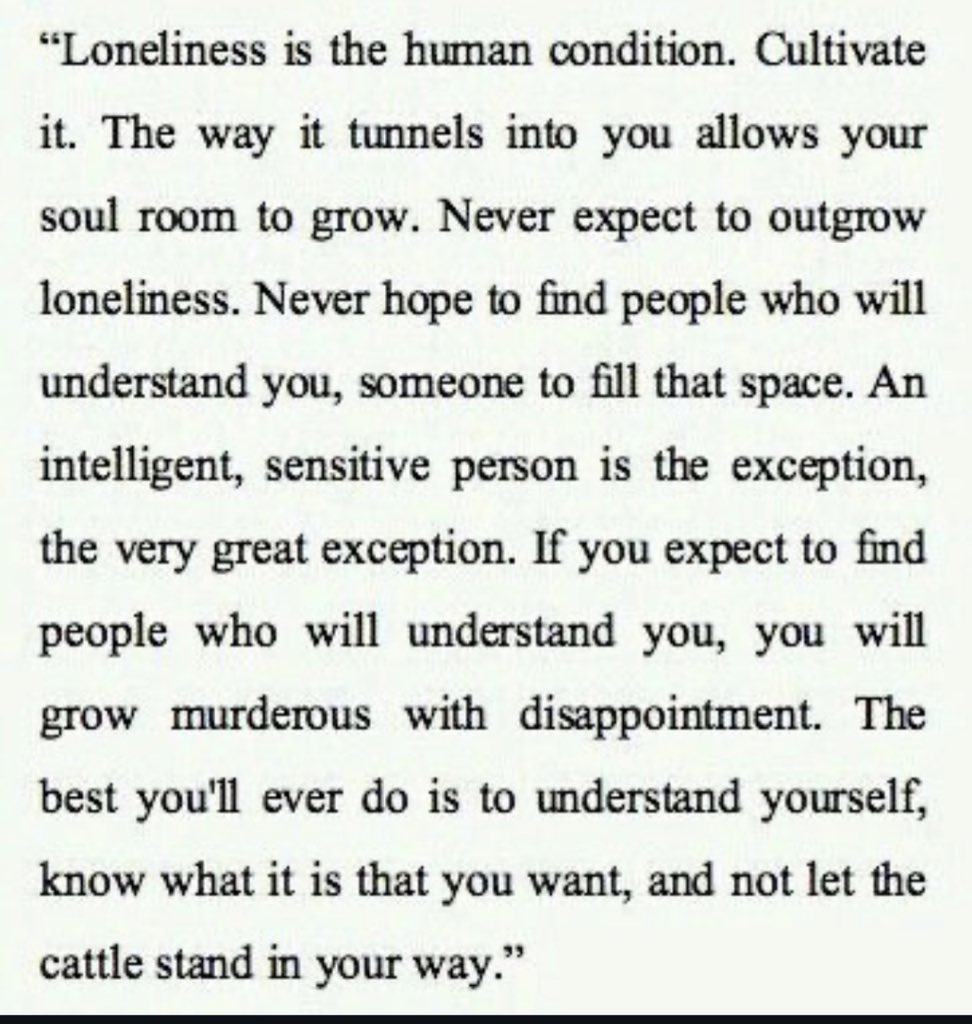
Loneliness
2026-01-19
Your reality is someone else's content
your reality is someone's content - by Adam Aleksic #culture #communication #social-media
I’ve written before about how there are two types of communication: the ritual kind, meant for connecting with other human beings, and the transmission kind, optimizing for distribution of information. Every new technology since the telegraph has continued to prioritize transmission at the expense of ritual. All that matters is how much you can communicate, to how many people—everything is done for views.
But ritual is what gives life meaning. There’s a reason it feels better to talk with a friend on a picnic blanket than watch your friend’s TikToks for the same length of time. Either way, you’re getting the same amount of information about your friend, but only the picnic feels special.
These are only the most obvious examples. I think the viral Sydney Sweeney ad last summer was another example of clip farming, just less on the nose. The real advertisement wasn’t the weird genetics joke, but the subsequent discourse around the advertisement. The purpose of the campaign was to make people uncomfortable enough to talk about it online, and now American Eagle stock is up 100%.
The more we rely on the transmission view of communication, the less incentive there is to treat other people with care. Companies like Cluely can raise millions of dollars by promoting academic dishonesty, and crypto scammers can inflate the value of their shitcoins by popularizing racist memes. If the point is distribution above connection, it’s okay to hurt other people as long as your message gets across.
Friction was the feature
Friction Was the Feature - John Stone's Blog #ai #slop
Today, a candidate armed with an LLM can parse dozens of job postings, lift phrasing from each, and generate a set of keyword-optimized cover letters in no time. They can auto-tailor their resume to each posting. They can submit 30 applications in one sitting.
This is better, right?
Not for anyone, actually. Applications soar; recruiters drown. So we bolt on more automation: applicant tracking systems, resume parsers, AI interview schedulers. We convince ourselves we’ve built a better machine, but we haven’t redesigned the only machine that matters: the system matching the right people to the right work.
…
We automated the production of artifacts but haven’t fixed judgment. The result is a marketplace of immaculate verbiage with very little meaning, of noise without signal.
Everyone looks more “efficient.” Very little about it feels effective.
Recruiting is just one place where friction used to be the feature. When the marginal cost of creating words falls toward zero, any system that uses those words as a proxy for quality begins to fail.
For a long time, we treated certain artifacts as measures of effort or quality. A thoughtful cover letter. A carefully written reference on behalf of a colleague. A multi-page strategy doc. They were hard enough to produce that their existence told you something about the person behind them.
Once AI arrived, those artifacts quietly turned into targets. We told people to personalize outreach, respond to more emails, and write more detailed documents. LLMs optimize for those metrics beautifully. But as they do, the metrics stop tracking the thing we actually care about: competence, sincerity, fit, progress.
This is what I call “Goodhart’s inbox”. We’re surrounded by messages and docs that perfectly satisfy the surface criteria we asked for. But the more we optimize for these outputs, the less focused we are on outcomes: whether anyone is actually understanding each other or moving work forward.
2026-01-18
Guardian Profile on Adam Tooze
The crisis whisperer: how Adam Tooze makes sense of our bewildering age | Economics | The Guardian
I am an unabashed Tooze Boy, so I thoroughly enjoyed reading every bit of this long article.
Anil Dash on a Career in Tech
How the hell are you supposed to have a career in tech in 2026? - Anil Dash #jobs #software
The first, and most important, thing to know is that it’s not just you. Nearly everyone in tech I have this conversation with feels very isolated about it, and they’re often embarrassed or ashamed to discuss it. They think that everyone else who has a job in tech is happy or comfortable at their current employers, or that the other people looking for work are getting calls back or are being offered interviews in response to their job applications. But I’m here to tell you: it is grim right now. About as bad as I’ve seen. And I’ve been around a long time.
The public narrative is dominated by the loud minority of dudes who are content to appease the egos of their bosses, sucking up to the worse impulses of those in charge. An industry that used to pride itself on publicly reporting security issues and openly disclosing vulnerabilities now circles its wagons to gang up on people who suggest that an AI tool shouldn’t tell children to harm themselves, that perhaps it should be possible to write a law limiting schools from deploying AI platforms that are known to tell kids to end their own lives. People in tech endure their bosses using slurs at work, making jokes about sexual assault, consorting with leaders who have directly planned the murder of journalists, engaging in open bribery in blatant violation of federal law and their own corporate training on corruption, and have to act like it’s normal.
This too shall pass. One of the great gifts of working in technology is that it’s given so many of us the habit of constantly learning, of always being curious and paying attention to the new things worth discovering. That healthy and open-minded spirit is an important part of how to navigate a moment when lots of people are being laid off, or lots of energy and attention are being focused on products and initiatives that don’t have a lot of substance behind them. Eventually, people will want to return to what’s real. The companies that focus on delivering products with meaning, and taking care of employees over time, will be the ones that are able to persist past the current moment. So building habits that enable resiliency at both a personal and professional level is going to be key.
As I’ve been fond of saying for a long time: don’t let your job get in the way of your career.
Laptop Boyfriends
[The Laptop Boyfriends Can’t Stop Watching YouTube in Bed](https://archive.ph/XNB0H#selection-2381.0-2388.0
…YouTube has joined sleep and sex on the short list of activities that occur between the sheets. “The post-coital cigarette is a lost art, so now it’s the post-coital vape and YouTube,” says Weeks. In Gaffney’s relationships, he believes “it was the time and place in which I consumed that was the issue.” He imagines his romantic partners “probably would’ve wanted to do things sexually and that opportunity wasn’t afforded to them because I was watching YouTube.”
Nadia, 30, lives in Paris with her software-engineer husband, who is also 30. She first became aware of his YouTube obsession while watching the Netflix reality-competition series Culinary Class Wars together. Bafflingly, he could identify esoteric gastronomy techniques and recognize chefs from restaurants he’d never even visited. “He just knows so much,” she says. “And I know it’s all from YouTube because he’s not, like, reading cookbooks frequently.” (Nadia asked to go by only her first name for privacy.)
But for every relationship in which YouTube is a bridge between partners, there’s another in which it’s a wedge. For Nadia’s husband, YouTube is a solo activity that exists in addition to shared television time. “Sometimes after a day of socializing, he specifically can’t focus on something on the TV or a 45-minute Netflix show, so he has to watch a 20-minute YouTube show and then another 20-minute YouTube show,” Nadia says. “Once a week, he’s like, ‘No, give me my loafing time with my YouTube alone,’ because apparently watching a movie with me is socializing.”
When pressed to explain why men do this, many I spoke to point to YouTube’s supposed educational value. “ I’m in awe of the magnitude of YouTube, how I can really go down any wormhole and learn anything I want,” says Gaffney.
There is a pervasive sense that time spent on YouTube is more edifying than time spent on, say, TikTok. “He’s somebody that hates the idea of wasting time,” says Watters of his YouTube Shorts–loving partner. The content “is still entertainment, but he can justify it like he’s getting smarter, he’s gaining knowledge. This is valuable.”
I suppose 👆🏽 is one way to justify a YouTube addiction.
2026-01-17
Einstein on being a loner
“I am a typical loner in my daily life... my awareness of belonging to the invisible community of those who strive for truth, beauty, and justice has prevented me from feelings of isolation.” — Albert Einstein
This totally made my day. I am very much a loner, but in talking with many folks I have realised that I have very rarely been miserable about it. On the contrary I would say I am pretty happy loner.
Cracked Engineers
Forget Vibe Coders: ‘Cracked Engineers’ Are All the Rage in Tech — The Information
Not exactly the kind of article
In November, a young robotics startup called Gradient began interviewing applicants for an engineering internship at the Palo Alto, Calif.–based company. But after talking to a half-dozen of them, the startup decided to ditch its plan to add interns.
Why exactly? “Not worth our time,” said J.X. Mo, 23, Gradient’s co-founder. While some of the applicants had seemed promising, “none of them would be cracked enough for us to hire them,” he said.
These days, plenty of people within tech are after the same thing Mo is: a “cracked engineer,” a buzzphrase that describes an idealized version of a software engineer capable of thriving in the AI era through scrappiness, workaholism and technical savvy.
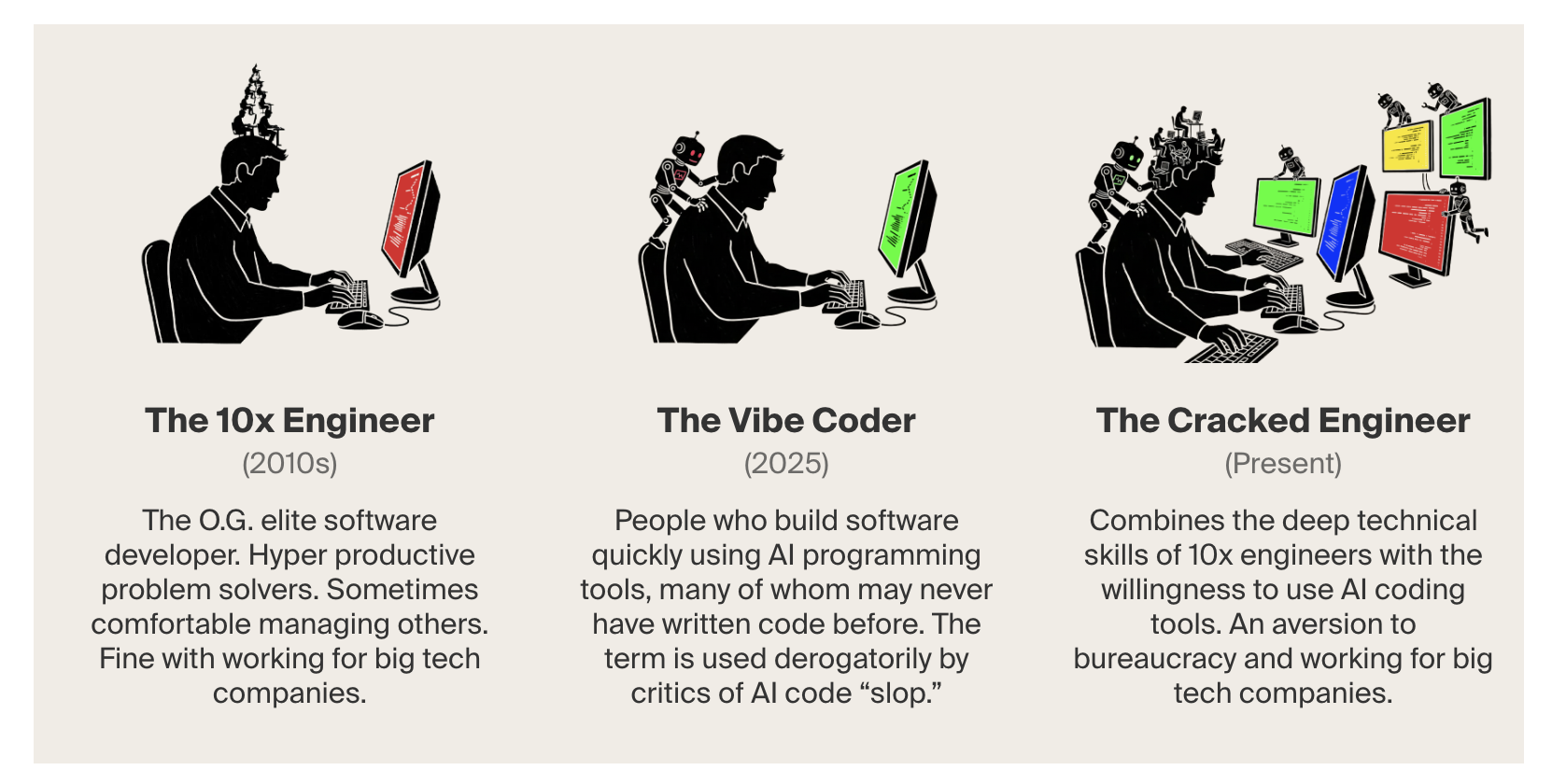
After looking at this figure, I figure I would put myself more in the category of a 5X engineer with the "willingness to use AI tools" and "capable of thriving in the AI era through scrappiness, workaholism and technical savvy", EXCEPT I am not exactly a workaholic 🙃. Does that make me "semi-cracked" then!?
Before it became a banner for a certain kind of programmer, the term “cracked” originated from videogames, as slang describing an especially adept gamer. Someone with a series of gnarly kills in Call of Duty? They’re totally cracked—that kind of thing.
Within tech, the people most eager to hire a cracked engineer are often startup founders at early-stage companies that haven’t yet accumulated significant venture capital. With limited funds, they need engineers who can operate as the company’s only coder—or perhaps one of a handful at most. And while some engineers specialize in writing code for machine learning or cloud infrastructure, cracked engineers are versatile enough to do it all.
Furthermore, these founders often view cracked engineers as more likely to be undiscovered savants who aren’t after cushy positions at big tech companies, rather than programming veterans. They are typically in their 20s, but they may have accumulated a decade of work experience by the time they reach their mid-20s, startup founders say. Most have little interest in managing other people.
Flat White Under Attack
Is There Really Such A Thing As A Large Flat White? | Sprudge Coffee
My vote is No.
The flat white is under attack. Or at least according to one Guardian contributor. The aggressor? Milk. More milk. Flat whites apparently now come, confusingly to some, in two sizes—small and large—which some see as a grave offense to the hallowed Antipodean espresso drink.
Except there is one tiny little difference between the flat white and the other drinks listed. What makes the flat white different is that there is no agreed upon definition of the flat white. Even among Australians, who spread it around the world, and New Zealanders, who in actually invented it. We know because we asked thousands and thousands of them all about over a decade ago, when arguing about flat whites still seemed novel. The closest thing to agreement we could find in our survey was that the flatty was “small-ish”. Think of it like a small latte. Further confounding things was the lack of consensus on whether a flit whoite had a double shot of espresso or a single. Ratios here are just as important, if not more, than total drink size, so that’s not ideal.
2026-01-11
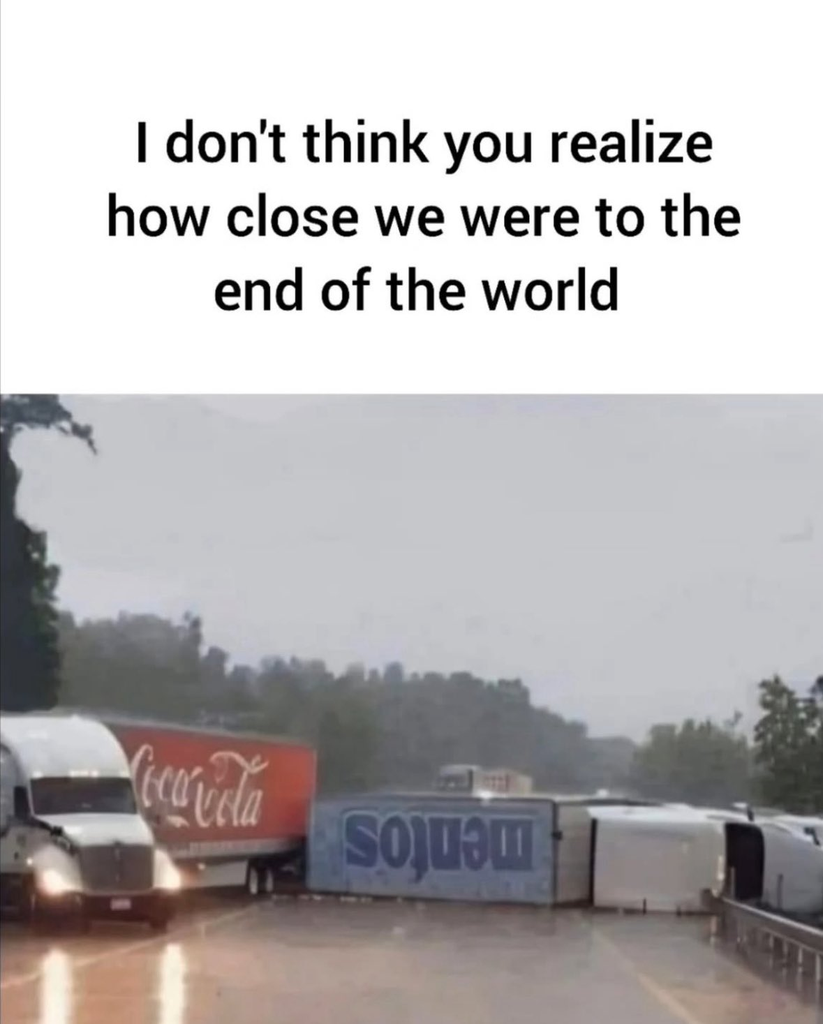
The end of the world
From: Laura Manach :bongoCat:: "#Meme #Humour" - Mastodon
Very relatable atm.
Tsundoku
I knew this term, but I liked how the tweet came together with the pics and everything.
In Japanese, "tsundoku" means collecting books and letting them pile up, not for neglect, but for the joy of knowing they're there, full of untold stories.
RIP Sweetgreens
The Rise and Fall of the Ultimate Millennial Power Lunch #salad #millenial
It seems like just yesterday when I was ordering Sweetgreens on the app several times a week and walking the few blocks in from my apartment (or WeWork) in NYC (where I was living at that tmie) to pick it up from the store. How things have changed!
In the first two months of last year, Sweetgreen’s stock price had declined more than 30 percent. The company had already made significant changes, dropping seed oils, adding “protein plates,” and hiring a bunch of robots in an apparent effort to cater to the early 2020s’ three defining dining trends: the MAHA movement, the protein fixation, and the push to cut costs by eliminating human labor. But not even air-fried potatoes could stop Sweetgreen’s free fall. In August, with operational losses reaching $26.4 million, the chain fired workers, and also the fries. As the year ended, Nathaniel Ru, who co-founded the company in 2007, stepped down from his role. Today, a share of Sweetgreen stock costs less than $8. In late 2024, it was more than $43.
…
Sweetgreen’s early success was not a fluke. As a restaurant, it truly did do something incredible. The company put high-quality organic produce in interesting combinations, incorporating fresh herbs and global ingredients, and going heavy on crunch and citrus. It sourced from small farms that it listed proudly on chalkboards inside each store, appealing squarely to a cohort who knew they really should be shopping at the farmers’ market, even if they usually got their groceries from Instacart, guiltily. And Sweetgreen was an early adopter of online ordering, allowing its customers to waste less time waiting in line. When a Sweetgreen opened in my city, in 2016, replacing a restaurant that had been serving hamburgers for 65 years, I was excited about it the same way I was excited when fiber internet came to my neighborhood: Finally, a better way to live.
The next paragraph makes me feel very seen (not in a good way!)
Sweetgreen was what you ate while listening to, if not the Hamilton soundtrack, then a self-improvement podcast at 1.5 speed, ripping through emails or shopping online before dutifully composting your beautifully designed, biodegradable bowl. It was the perfect fuel for the grinning strivers of the long 2010s, when a better world was possible, and in fact something you could buy. When a dear friend of mine got married, what she wanted to eat more than anything else while being poked and prettied in the hotel suite was Sweetgreen. It was the most reliable, most delicious, least risky meal either of us could think to pick up at an exceptionally frenetic moment. But it also made sense, spiritually, on a day that often requires total command over both one’s appearance and a large number of spreadsheets—a day that is a public declaration of hope for the future, and, in some ways, the first day of your adult life.
I think Sweetgreen didn’t change so much as the world around it did. A $15 salad was never really an investment in one’s health, but it certainly doesn’t feel like that in this economy—and besides, that moment has passed. The optimism of the previous era has given way to something more nihilistic. The people who were once going to guac this week are now quiet quitting and scarfing tallow. The “power” in Millennial power lunch has, largely, been replaced by impotence and apathy. WeWork went bankrupt; Hamilton became cringe; trying so hard to do the right things all the time started to feel pointless and naive. When I told a friend and fellow former Sweetgreen enthusiast about this story, he said, “What’s the point of eating a salad when we’re all going to die?” He was joking, kind of.
Morning Coffee Rave Parties ftw
An aversion to alcohol is making sober raves an increasingly popular party option | CNN
On a Saturday morning in October, Park Jihyun woke up at 5:30 a.m. to go raving in Seoul.
And much about her prep routine was counterintuitive.
Instead of shimmying into a miniskirt, the 29-year-old pulled on a pair of running tights. Instead of slipping her feet into a set of precarious heels, she slipped into running shoes. And in lieu of hailing a cab to the party, she ran from her apartment to the venue in Yongsan-gu, arriving after an hour-long, 5-mile jog, ready to hit the dance floor.
“It’s just random people who meet for the first time. But as we start dancing together, it becomes crazier as time flies,” Park says.
Since launching in May, the Seoul Morning Coffee Club’s Coffee Rave has become a viral success, drawing hundreds of like-minded Seoulites from the comfort of their beds to dance at daybreak.
Attendees, who have paid 20,000 won (about $14) for their ticket, start trickling in at 7 a.m., and line up for their drink of choice, often an iced Americano or a matcha. By 8 a.m., the DJ is pumping out hypnotic bass beats for an enthusiastic crowd of revelers who are jumping in unison in the clear, bright light of day, with nothing but caffeine to fuel their booze-free rave.
2026-01-10
Should you have a library in your loo
Should you have a library in your loo? #library #loo
I swear I had not thought that an entire article could be written on this topic.
The design world, for the most part, is on board. Furniture maker Matthew Burt recently launched the Loo Library, a beautifully compact shelving unit in walnut and stainless steel with semi-circle cutouts in the corners, designed to fit snugly into even the smallest cloakroom. “The idea was to create something with interest and gravitas, while ensuring books could be easily reachable from the loo,” says Burt.
Because it’s not just an issue of title selection (we’ll come to that) — positioning is key in a loo library, too. Books can’t be too close to the pan or too low to the ground, but must be within grasp from a seated position. Unlike the bedside table, in the loo you are privy to both hazards and logistical impediments. The books must be light enough to be easily held, not too precious, but also not too dog eared or well thumbed.
…In Japan, there is a term, mariko aoki, to describe the urge to defecate when entering a bookstore — a phenomenon born, perhaps, from some deeply held or Pavlovian association of reading and the loo.
2026-01-08
Coffee in California
A California Gesha Makes Its International Auction Debut | Sprudge Coffee #coffee #california #usa
TIL, coffee is grown in California
When you think of coffee production in America, the first place that comes to mind is undoubtedly Hawaii, Kona in particular. But it is not the only state commercially growing coffee. California is home to a few extremely small coffee farms, though few have risen above novelty; even the most avid specialty coffee drinkers are unlikely to have ever tasted any. But that may be changing soon thanks for Frinj Coffee. The Ventura-based farm will be the first continental American producer to take part in an international coffee auction.
2026-01-05
A Metabolic Workspace #productivity
There is a rude but clarifying question here: are you collecting information to use it, or are you collecting information because collecting feels like intellectual work? If it's the latter, you're not building a Second Brain; you're building an anxiety management system that happens to look like productivity.
Ranking Classical Philosophy Books
From: Correcting an Error - by Jared Henderson
It's a 4hr video, so not sure when I am gonna get around to it. But wanted to log it here so that I could point to it next time.
2025 GenZ Trends
Nostalgia Economy and Analog Awakening #genz #buzzwords #slang
For some random reason I have this GenZ Trends newsletter in my feed reader which has become a bit of a guilty pleasure to read.
In the 2025 recap, I came across this long list of buzzwords. Some of my favorites
Slop life: Acceptance of overstimulating, low-quality consumption as a default mode. (I, II, III)
…
Locking in: Self-optimization as a seasonal ritual. (I, II)
…
Restivals: Festival culture shifts toward livestreaming and at-home experiences rather than physical endurance. (I, II)
…
Floodlighting: A dating term for oversharing trauma early to manufacture intimacy; an emotional jump scare. (I, II)
…
Monkey barring: Dating behavior where someone lines up the next relationship before letting go of the current one, swinging from partner to partner without ever being single. (I, II)
Monk mode: A self-imposed period of extreme discipline and withdrawal framed as productivity-driven, often involving no dating, no socializing, and obsessive self-improvement. (I, II)
…
What To Buy That Improves Quality of Life
What To Buy That Improves Quality of Life #things #buyitforlife
A good list.
2026-01-04
The gap between a Helpful Assistant and a Senior Engineer
The gap between a Helpful Assistant and a Senior Engineer : ezyang's blog
One of the important functions of a senior engineer is to be able to evaluate the context a software project lives in and figure out if we need to do something, even if it isn’t explicitly asked for. This is contrast to a helpful assistant, who is first and foremost obligated to follow the user’s instructions. This leads to a gap between a Helpful Assistant and a Senior Engineer.
Well, imagine a human L7 engineer who has just been hired by a big tech company to head up some big, new, multi-year initiative. Will they say, “Sure, I can help with that!” and start busily coding away? Of course not: they will go out and start reviewing code, reading docs, talking to people, asking questions, shadowing oncalls, doing small starter tasks–they will start by going out and building context. Here, the “helpful assistant” frame for LLMs is limiting: sure, Claude might ask you a few questions to clarify the task upfront, but if your coding agent starts asking you about “relevant partner teams” and “org-wide priorities for this half” you are definitely going to raise an eyebrow.
Thorsten Bell on AI Assisted Coding
Joy & Curiosity #68 - by Thorsten Ball - Register Spill
For more than 15 years I thought that I loved writing code, that I loved typing out code by hand, that I loved the “cadence of typing”, as Gary Bernhardt once called it, when sitting in front of my editor and my fingers click-clacking on my keyboard.
Now, I’m not so sure anymore.
2025 was the year in which I deeply reconsidered my relationship to programming. In previous years I had the occasional “should I become a Lisp guy?”, sure, but not the “do I even like typing out code?” from last year.
What I learned over the course of the year is that typing out code by hand now frustrates me. It frustrates me in the same way that filling out a printed form by hand frustrates me. Writing my name and middle name and last name and my street address and my zip code in capital letters with this stupid pencil when all of this could’ve been done by a computer, god, why do I have to do this, why do you punish me? This is so stupid, so laborious, this shouldn’t exist. I once considered not taking the 50 Euros of reimbursement that Deutsche Bahn offered after a train was delayed for two hours because I would have had to fill out a form by hand.
Amp is now faster and better at writing code than I am and whenever I do have to go in and type some code it feels like I’m pulling out the sewing needle after the sewing machine broke down, like hammering nails by hand after the nail gun’s battery died.
And yet it was fun! It was fun to write code by hand, for many, many years, and when it stopped being fun I was sad. Do I even love programming and building software if the actual writing of code is now a nuisance?
And the sadness went away when I found my answer to that question. Learning new things, making computers do things, making computers do things in new and fascinating and previously thought impossible ways, sharing what I built, sharing excitement, learning from others, understanding more of the world by putting something and myself out there and seeing how it resonates — that, I realized, is what actually makes me get up in the morning, not the typing, and all of that is still there.
One Day, Everyone Will Have Always Been Against This
One Day, Everyone Will Have Always Been Against This: National Book Award by Omar El Akkad: 9780593804148 | PenguinRandomHouse.com: Books #palestine #gaza
On October 25, 2023, after just three weeks of the bombardment of Gaza, Omar El Akkad put out a tweet: “One day, when it’s safe, when there’s no personal downside to calling a thing what it is, when it’s too late to hold anyone accountable, everyone will have always been against this.” This tweet has been viewed more than 10 million times.
2026-01-02
Common People
“I wanna live like common people
I wanna do whatever common people do
Wanna sleep with common people
I wanna sleep with common people like you”
Well, what else could I do?
I said “I’ll, I’ll see what I can do”
– Pulp, Common People
Found here: The Watching Menace: Crowds, Voyeurism and Photography - Flashbak
Hope is a discipline
Pluralistic: The Post-American Internet (01 Jan 2026) – Pluralistic: Daily links from Cory Doctorow #ccc #ai #law
Like I said at the start of this talk, I have been doing this work for 24 years at the Electronic Frontier Foundation, throwing myself at a door that was double-locked and deadbolted, and now that door is open a crack and goddammit, I am hopeful.
Not optimistic. Fuck optimism! Optimism is the idea that things will get better no matter what we do. I know that what we do matters. Hope is the belief that if we can improve things, even in small ways, we can ascend the gradient toward the world we want, and attain higher vantage points from which new courses of action, invisible to us here at our lower elevation, will be revealed.
Hope is a discipline. It requires that you not give in to despair. So I'm here to tell you: don't despair.
NB: Hope is a discipline is a quote originally attributed to Mariame Kaba. I recently came across it and since then I have been seeing it everywhere. I think it's a pretty powerful statement.