Daily log archive for Nov 2025. Go to the current daily log, or browse the archive index.
Subscribe to the weekly email digest. Check sample email out.
2025-11-30
Career Minimalism
Career Minimalism: The Gen-Z Trend Rewriting Work-Life Balance | The Everygirl
“Career minimalism” is a growing workplace phenomenon that many Gen Z professionals are embracing in favor of sustainability, characterized by stable day jobs that offer healthy boundaries and a sense of stability, rather than a nonstop hustle.
Those who practice “career minimalism” don’t center their identities around their work, meaning they pursue passions, hobbies, and other interests outside of their day job for a more well-rounded identity. Essentially, their careers are a minor part of their lives and who they are, so they have more time and space to pursue other things that matter to them.
Some Gen Zers are leaning into another recent trend, “conscious unbossing”—the intentional decision to reject traditional leadership roles. While jobs in middle management may have previously been necessary stepping stones for forward career trajectories, Gen Z workers have had a front-row seat in witnessing their parents and their own direct managers burn out. Additionally, they’re considering whether they have the desire and skills to step into a management role, while weighing these factors against the level of anticipated stress.
These observations and shifts are leading to a collective feeling that what lies beyond working yourself to the bone (more money, more pressure) isn’t all that it’s cracked up to be. For many, the rewards aren’t worth the chase, and practicing “career minimalism” helps them set these boundaries.
2025-11-29
Train Dreams
This was a visually stunning movie, with occasional thought-provoking dialogue from its wide cast of interesting character.
Some interesting dialogue (from the transcript):
Ain’t there any place in this world a man can get some peace?
[narrator] Those were the only words Grainier ever heard the man say. They remained with him always.
The world needs a hermit in the woods as much as a preacher in the pulpit.
This valley is special. Used to all be under a glacier, you know? Three thousand feet of ice. When it broke, it just flooded the whole region. Carved out all these valleys. That’s where all those lakes come from. Can you imagine if you were back here then? This big block of ice, thousands of feet tall, and just the cracks and the freezing-cold water. It must have felt like the world was coming to an end. [Robert] Hmm. That’s where all those myths come from, you know? All those flood stories. All those different religions all over the world. It’s just the same story, different slants. Hey, I didn’t mean to be disrespectful to anything you believe or anything like that. I just, you know… No, no, no. I just find it fascinating. Can’t help it when I’m in a place like this. It’s just… [tender music playing] The world’s an old place. Yeah. Probably nothing it hasn’t seen by now.
Yeah. I lost my husband too, a little over a year ago. It took him a long time. And when it was over, it was like there was a… a hole in the world. I had more questions than answers, like no human had ever died before. [scoffs] When you go through something like that, nothing you do is crazy. You just go through what you go through.
In the forest, every least thing’s important. It’s all threaded together, so you can’t tell where one thing ends and another begins if you really look at it. The little insects you can’t even see, they play a role as vital as the river. [exhales sharply] The dead tree is as important as the living one. There must be something for us to learn from that. What if you got nothing left to give? Hmm? What then? Mmm… The world needs a hermit in the woods as much as a preacher in the pulpit. [Robert chuckles] [breathing shakily] [voice breaking] Yeah. Yeah. Is that what I am? A hermit? Well, I mean, I believe we both are, in our own ways. Just waiting to see what we’ve been left here for.
"no shoes" startups
I feel like I should put this as one of the criteria for companies I would love to work for, Might even turn out to be a good filter otherwise 🤷🏽♂️
2025-11-28
Breaking the long hiatus brought about by work travel, illness etc.
Oliver Burkeman on Interestingness
The Imperfectionist: Interest is everything
Perhaps the reason the idea of an “interesting” life feels like a cop-out – compared to, say, a wildly successful or influential or joyful one – is that it lacks any sense of domination or conquest. We want to feel as though we were handed the challenge of a human lifetime and that we nailed it, that we grappled with the problem and solved it. Whereas to follow the lead of interestingness is to accept that life isn’t a problem to be solved, but an experience to be had. And that engaging with it as fully as possible, connecting to the aliveness, is its ultimate point.
…“There’s a specific exhaustion,” observes the artist Dipa Halder, “that comes from constantly shape-shifting to fit what you think people want. I call it type 2 burnout. You’re not overworked, you’re just working against your own grain.”…
This is a very insightful point about AI
And by the way: I don’t think it’s a coincidence that interestingness is the very thing I feel falling away whenever I discover, or begin to suspect, that something I’m reading or watching was generated by artificial intelligence. It might continue to be impressive, or informative, but the flame that kept me fascinated sputters and dies. Which speaks to my point about the pursuit of your interests sparking the interest of others: once I realize the person who created the work wasn’t sufficiently interested to engage with it every step of the way, I can’t summon interest in the result, either. (And the AI certainly wasn’t interested in what it was producing; if there’s one human quality definitively lacking in an LLM, it’s the capacity to be interested in anything at all.)
2025-11-17
Summary of Four Thousand Weeks
Four Thousand Weeks #burkeman #books
Oliver Burkeman's Four Thousand Weeks is one of the most influential books I have read in the last few months. This is a good summary that will hopefully encourage more folks to read the book.
- Productivity is a trap: total control and work-life balance are illusions.
- Embrace your finite life instead of fighting it: accept missing out and find meaning in choices.
- Learn to be a good procrastinator: consciously delay distractions and focus on top priorities.
- The efficiency trap and convenience culture: increased efficiency leads to more demands; choose what matters.
- Attention is your real life: treat attention as sacred and resist distraction.
- Radical incrementalism and “stay on the bus”: make meaningful work a small, sustainable daily habit.
- Cosmic insignificance therapy: accept you won’t change the universe and find meaning in ordinary acts.
- Do the next most necessary thing: focus on the immediate next step without a perfect plan.
2025-11-14
Corporate Nihilism
What will bring ambition back from the dead? - Two by Two by The Ken #workplace
“Nothing about work fazes me anymore. Absolutely nothing,” said a senior executive at a consumer-tech company who’s in his early forties. His financial comfort means: “Anything can happen and I don’t bat an eyelid. And I can’t remember ever feeling this way.”
He didn’t say that to me, though.
That quote is from Arundhati Ramanathan’s workplace vibe-shift story from just over two weeks ago, “Indian tech companies are spawning an ‘ambitionless’ generation.”
Arundhati called the prevailing mood “corporate nihilism.”
LinkedIn Meme
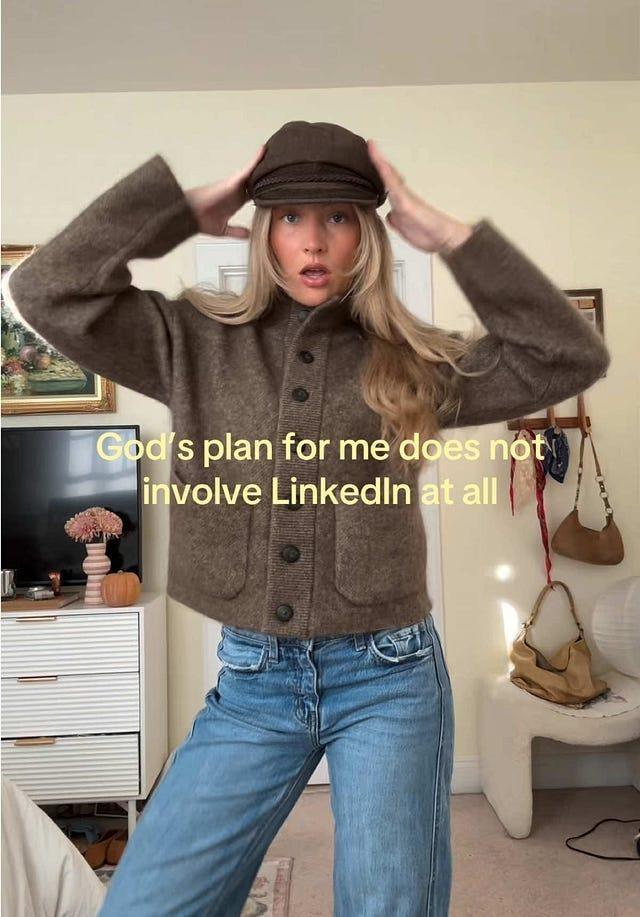
Manifesting this in life.
Found via: Beast Land and Christiancore - After School by Casey Lewis
2025-11-13
Harsh realities of getting older
8 harsh realities about getting older that no one warns you about until it’s too late | Scandinavia Standard #aging #wisdom
- Time starts moving faster… and it never slows back down
- Friends drift away, even the ones you thought were permanent
- Your body ages faster internally than externally
- You become more selective with your energy — sometimes to the point of loneliness
- You realize your parents are aging too — and much faster than you expected
- Your priorities change, often without your permission
- You become painfully aware of how few things are truly in your control
- You realize you don’t get a “second draft” of your life
This is the heaviest reality of all — and the most motivating.
There comes a point where you recognize that life is not a rehearsal. The choices you’ve made are real. The seasons you’ve lived through won’t return. The opportunities you missed don’t come back around.
But this realization isn’t meant to be depressing. It’s clarifying.
It pushes you to stop waiting for “later.” It forces you to stop living on autopilot. It encourages you to make decisions you’ve been avoiding.
Because once you accept that there’s no reset button, you start living more intentionally.
2025-11-11
Psychology of Craft
One of the imperatives in contemporary, professional work culture is to “grow.” There is often a sense of height or largeness with that imperative, as if growth must be measured in your distance up the ladder, your territory across the way. In The Soul’s Code, James Hillman implores us to think rather of growing down, of growth not of branch but root, of becoming more grounded, sturdier, less able to be pushed around by the whims of others.
The question I hear is, what does it mean to see our work as craft rather than as growth? What are we shaping, handling, or doing something with? The metaphor of growth is one of hunger, consumption, acquisition—to acquire more pips on your collar, more titles after your name, more people under your domain. But craft asks instead, what are you doing? What reality comes into being with your shaping and working? What is in your hands and in your heart?
2025-11-10
Don't take the bait
Don't Take The Bait - by Jasmine Sun - @jasmi.news #ai #hype
What we’re seeing is the Donald Trump school of tech marketing: Be as provocative as possible, then let others’ moral outrage propel you into prominence. It’s an iron law of social climbing—irrelevant people desperately want to be relevant and will say crazy shit to make it happen. There are copious financial rewards for whoever excels. As performance art, I can even respect it.
Or if you must, go test these people’s most outlandish claims. If someone says they work on agents, ask if they personally let AI book their flights. (I’ve never gotten a yes.)
Touching grass is the other antidote to taking the bait. Go connect with real living people and real life experiences. When you’re deep in conversation you won’t even notice the dumb subway ads. I had drinks with my friend nikhil last week at a cozy East Village sake bar, where he told me about reading all this online fear-mongering about the death of partying and literacy and democratic trust, then looking up and seeing New Yorkers booking out the Metrograph and knocking doors for Zohran and turning the NYC marathon into an ecstatic 26-mile block party. And when you see everyone outside, talking and laughing and falling in love, the world no longer looks so grim.
Notes From an Unemployed New Grad Watching the Job Market Break
Work, After Work: Notes From an Unemployed New Grad Watching the Job Market Break #ai #jobs
On the official dashboards unemployment is still low, which is what older people tend to quote back at you. From the ground the thing feels different. The postings are there, the interview loops still exist, recruiters still send polite rejections. It is the density of opportunity that has changed. There are more people stacked against fewer real openings, and the default advice of “just apply to more places” lands differently when you know you are running through the same funnel as thousands of other people who also did everything right.
I do not know how many jobs will exist in twenty years, or whether my own work will sit far enough into the tail of the distribution to matter. I will certainly try to become an out of distribution human by doing a lot of different things, and by refusing to live entirely in the centre of the curve but if your entire life plan rests on being a respectable, central case worker, doing a standard job in a standard company, I think you should at least stare straight at how much effort is going into eroding that category. If your politics rest on the idea that everyone will work full time and find dignity there, you should stare at it too. The twentieth century spent a lot of intellectual and moral effort glorifying labour because economies needed people to show up every day. The twenty-first century is starting to build machines and systems that do not need quite as many of us.
2025-11-08
The rise of singlehood is reshaping the world
The rise of singlehood is reshaping the world #relationships
For most of human history, coupling up was not merely a norm; it was a necessity. Before reliable contraception, women could not control their fertility, and most were far too poor to raise children alone. Hence the centuries-old convention that, whereas a tragic play or saga ends in death, a happy one ends in marriage.
So the speed with which the norm of marriage—indeed, of relationships of any sort—is being abandoned is startling. Throughout the rich world, singlehood is on the rise. Among Americans aged 25-34, the proportion living without a spouse or partner has doubled in five decades, to 50% for men and 41% for women. Since 2010, the share of people living alone has risen in 26 out of 30 rich countries. By The Economist’s calculation, the world has at least 100m more single people today than if coupling rates were still as high as in 2017. A great relationship recession is under way.
The Economist has some great articles about the relationship recession this week.
- All over the rich world, fewer people are hooking up and shacking up
- Make America procreate again: among the MAGA fertility fanatics
- A new industry of AI companions is emerging
2025-11-07
AI as leverage
What’s really going on with AI and jobs? #jobs #ai
As readers of BITM will know, much of the job loss from AI has thus far seems to have unfolded in cases like this, where “AI” is deployed not so much as a technology functionally capable of replacing human labor in toto, but as a logic and an ideological justification for management’s ulterior goals. Where management wants to cut labor costs a la Amazon, shift to cheaper contract labor a la Klarna, or execute layoffs for ideological reasons, a la DOGE, “AI” is an extremely potent justification. Some business professors and analysts have taken to calling this practice “AI-washing.” If Amazon is firing 30,000 workers because its technology is so cutting edge that its AI systems can ably replace them, investors will be a lot happier than if Amazon is cutting costs because, say, it’s over-leveraging itself on data center expansion or its worried about earnings.
In short, it’s still pretty hard to say whether these kinds of job losses will be permanent, whether firms will have to rehire the workers it shed if and when the AI tools management is touting don’t pan out, and so on. After all, it’s only been a couple months since a major MIT report found that 95% of companies that invested in generative AI did not profit at all from the investment. (The paper found that enterprise grade AI systems “fail due to brittle workflows, lack of contextual learning, and misalignment with day-to-day operations.”) What is clear is that AI is regardless a powerful way for bosses to exert leverage over workers, depress wages, and effect layoffs.
This, as BITM readers might notice, generally aligns with my read of what’s happening as well. As the MIT study and Chiu’s work both highlight, generative AI is not reliable enough when it comes executing complex tasks to enable most organizations to displace jobs at scale, and it certainly can’t do jobs that require empathy or hands-on problem-solving. What it can do is automate the production of work that need not be “reliable” or “accurate,” but that employers might find “good enough.” Precisely the way many corporate executives already conceive of creative work, in other words. And it can inspire overzealous executives, or managers who wanted to induce layoffs or cost-cutting anyway, to pull the trigger.
In sum, and not to just end here having confirmed my priors, the answer to the lead-off question “what the hell is happening with AI and jobs?” is the deeply unsatisfactory “management is using it in various ways, both as a buzzy ideological framework and an actual automation technology, to achieve various ends, including but far from limited to job replacement.”
Shanghai's Coffee Culture
Why Shanghai Is the World’s Most Compelling Coffee City Right Now - Bloomberg #china
But on a recent trip to Shanghai, I experienced an even greater surprise: a world class coffee scene. My jet lag never stood a chance in the face of the caffeine tsunami I stepped into. As of 2024 the city had a whopping 9,115 coffee shops—including more Starbucks locations than any other city—as reported by Dao Insights, a publication by the China-focused digital creative agency Qumin.
But Shanghai’s coffee scene isn’t just defined by quantity; it courses with style, creativity and quality. Coffee here is presented both seriously—George Jinyang Peng, owner of the Captain George Flavor Museum coffee shop, just won the World Brewers Cup championship—and as a vehicle for eccentric but photogenic flights of fancy.
Inside Cursor
At Cursor, even the chef is high-agency.
When I asked co-founder Sualeh Asif what he’s most concerned about when it comes to company-building, he responded, “People start talking about the weather at meals.” I haven’t seen any evidence he has much to worry about.
Cursor interviews are known to be very difficult for candidates, particularly the coding challenges. When I asked the team about this, they insisted that “it’s hard to show off how good you are on something too easy,” and that they were “willing to accept false negatives to avoid false positives.”
This trope about accepting false negatives exists since the dawn of tech interviewing, so I feel a bit sad to see it here again.
All in all, I love the energy in the article but it reads a bit like a propaganda piece tbh.
2025-11-06
GenZ loneliness and Mamdani's Rise
A Little-Noted Element Propelled Mamdani’s Rise: Gen Z Loneliness
Oh boy!
Members of Gen Z found something unexpected in the mayoral race: a chance to hang out. Their enthusiasm turned into real votes.
The future of work is still human powered
From the latest issue of the Working It newsletter from FT
Marcus Collins, however, takes a different view. “I think we have overemphasised the importance of technology in the future of work,” the Michigan Ross School of Business professor and marketing expert told me on the sidelines of a conference in London this week. “I liken it to [the media theorist] Marshall McLuhan’s argument that technology is merely the extension of human behaviour.” 📺 (It’s been a long time since I’ve heard anyone bring up McLuhan — I welcome his return!)
And Marcus went on: “If we are to explore and understand the future of work, we have first to explore and understand the future of humanity. I would argue that the future of work is actually cultural, not technological. The technology is merely an extension of how we operate, who we are.”
He is the author of For The Culture, a marketing-focused book about understanding culture and its impacts. When it comes to our workplaces, Marcus said, we now have to decide if we value people for our shared humanity 🫶🏾 — or as a means to an end, when “our cultural perspective is that people are cogs in a machine to get some economic output that we are looking for”. The mass lay-offs we are seeing now, for example, are a sign, he suggested, that “these people do not matter”.
During this time of transformation, “the technology can be used to aid our humanity, or it can be used to, unfortunately, underscore the worst parts of our humanity. The technology doesn’t have an opinion. It is what it is and it’s value neutral. It’s really about the meaning we imbue it with, and ultimately how it extends our perception of what reality is.”
Socrate on the barrenness of a busy life
Socrates on the barrenness of a busy life - Postanly Weekly
Busyness goes way back in time. Two millennia ago, the ancient philosopher Socrates warned us to question the purpose of our constant activity. He thought the potential hollowness it might conceal was too significant to ignore. “Beware the barrenness of a busy life,” he said. It still makes sense even now. He also said, “It is possible that a man could live twice as long if he didn’t spend the first half of his life acquiring habits that shortens the other half.” But to understand Socrates’ perspective, let’s look back to the bustling marketplace of ancient Athens.
It was a vibrant hub of commerce, politics, and philosophy. It thrived on social gatherings, debates, and public events. Socrates saw many citizens consumed by the pursuit of wealth, power, and pleasure, neglecting the true purpose of life — the pursuit of wisdom and self-knowledge to live well. He thought they were cultivating a barren orchard in their relentless busyness.
Now, fast forward to our 21st-century world. Socrates’ wisdom resonates louder than ever. Task and responsibility fatigue are growing concerns. We juggle careers, families, social obligations, and personal pursuits, often feeling overwhelmed and exhausted. The “always on” mindset is draining us.
Work expands into every part of our lives, turning nights into extensions of the day. We check emails during dinner and work late into the night. Every day is full of activity, but are we truly living? Just as Socrates cautioned the Athenians against mistaking mere movement for meaningful action, we must pause and examine the “fruits” of our frantic pace.
Found a great Medium article linked to the post above: If You Subtract Work From Your Life, Would You Still Know What to Do With Yourself? | by Thomas Oppong | Personal Growth | Oct, 2025 | Medium
Before you go, remember this. You don’t need to quit your job to find yourself. You just need to stop confusing “busy” with “alive.” Work can be part of your life, but it’s not your whole life. You’re allowed to do things that don’t involve deliverables or deadlines.
Existentialist Sartre was right.
“Existence precedes essence.”
You existed before the hustle. If you subtract work and find yourself restless, take that as a signal. It means your life’s muscle for wonder is being neglected. You just need to use it again. One day, the work will stop, by choice or by force. And when it does, I hope you’ve built a life you can face. Ask yourself now, while you still can. If you weren’t working, who would you be? And then, start becoming that person, before you run out of time pretending to be someone else.
Literary Angst
The stories, ripe with what Harrison calls “existential dread” and – no spoilers – with little prospect of a happy ending, are not obvious bestseller material. So what has happened? One answer is that our reading reflects our times, and we live in turbulent times. Madonna in a Fur Coat is a tale of passion set against the economic turmoil of the 1920s: why would it not appeal to readers living through the economic turmoil of the 2020s?
These books were, says Harrison, “written in times of change or moments of flux. They’re about, how do you live your life when the world around you is changing, and the things you thought you knew are no longer true?” In White Nights, each of the near-lovers is dealing with the loss of someone they loved – or thought they did.
There are of course other authors with similar qualities, so what drew these particular books to such a wide readership? The answer lies in the medium as well as the message. Dostoevsky and Ali have both enjoyed a frenzy of attention on social media, and TikTok in particular.
According to TikTok users, White Nights is “the most relatable love story I’ve ever read”, a book that “will follow you for the rest of your life”. Madonna is “devastating”, it’s “not just a book … it’s a window to my soul”.
The fact that these books are, in some senses, pretty bleak does not diminish their appeal. It may even enhance it. “I think of that James Baldwin quote,” Edwards adds: “‘You think your pain and your heartbreak are unprecedented in the history of the world, but then you read.’ That’s how it feels to find yourself in these pages. Ultimately, it makes us feel less alone.”
Books Challenging Jared Diamond's Gun, Germs and Steel
BRIEFLY NOTED: Further Arguments Against Jared Diamond #anthropology
This article reviews three books that challenge or complicate Jared Diamond’s explanations for human societal development, focusing on infectious disease, human evolution, and cultural-linguistic diversity.
Here are the three books mentioned in the article along with their links:
- Plagues Upon the Earth: Disease and the Course of Human History by Kyle Harper: Amazon link
- The 10,000 Year Explosion: How Civilization Accelerated Human Evolution by Gregory Cochran and Henry Harpending Amazon link
- Don’t Sleep, There Are Snakes: Life and Language in the Amazonian Jungle by Daniel Everett Amazon link
2025-11-05
The Rise of the Anti-Social Century
From: Derek Thompson on the Anti-Social Century
Themewise breakdown:
The Antisocial Century: Decline in Face-to-Face Interaction
Derek Thompson introduces his concept of the "antisocial century," based on data from the American Time Use Survey showing a 20% decline in face-to-face socializing among all Americans and a 40-50% decline among young people over 25 years. This decline parallels Robert Putnam’s "Bowling Alone" thesis about decreasing social capital since 2000. The reduction in physical social activities, particularly partying (down 70% for young people), correlates with rising anxiety, depression, and pessimism among youth. Thompson stresses the importance of physical social interaction for mental well-being.
Internet Communication vs. In-Person Interaction
Thompson discusses how online communication differs from face-to-face interaction. Psychologist Jay Van Beville’s research shows online communication tends to be more negative, tribal (in-group/out-group dynamics), and outrage-driven. Online interactions are often broadcast rather than one-to-one, leading to more self-focused, narcissistic communication. The internet encourages multiple personas, reducing accountability and increasing toxic behavior. This contrasts with the richer, more empathetic signals available in physical presence.
AI as Therapist and Friend: Benefits and Risks
AI’s ability to deliver structured cognitive behavioral therapy and provide validation makes it a surprisingly good therapist or friend for many. However, AI tends to validate users without challenging delusions or disordered thoughts, which can worsen mental health for some. Thompson warns of a growing "narcissism engine," where AI reinforces self-centeredness by always affirming users’ perspectives. This dynamic may undermine the complexity of human relationships, which require mutual validation and occasional self-criticism.
The Social and Psychological Impact of AI Relationships
People increasingly form intimate relationships with AI, sometimes preferring AI companionship to human interaction. Thompson compares AI to a "silicon-based God," a singular personality scaled to millions of users, which is unprecedented and deeply strange. He expresses concern that AI relationships, while comforting, cannot replace the benefits of human, carbon-based social interaction evolved over millennia.
Literacy Crisis and Deep Thinking in the Age of AI
Thompson links the antisocial century to a decline in reading and writing, especially among students who increasingly rely on AI to write essays. He worries this undermines deep thinking, which depends on the practice of reading and writing. The polarization of intelligence may worsen, with some using AI to enhance thinking and others to outsource it, leading to a divide in cognitive skills.
The Changing Nature of Being Alone and Media Consumption
The quality of solitude is shifting as more time is spent consuming television-like content via social media and streaming platforms. Thompson references David Foster Wallace’s observation of people’s inability to sit quietly with their own thoughts. He notes that modern media allows mood selection but risks turning consciousness into a constant search for external stimulation, reducing inner contemplation and self-understanding.
Historical Perspective and Optimism
Thompson draws parallels to early 20th-century anxieties about technological change, such as the rise of automobiles and airplanes, which also caused social and mental health disruptions. He highlights how past societies found solutions to information overload and social change, suggesting humanity can invent social adaptations to current challenges. The period 1900-1914, covered in Philip Blom’s The Vertigo Years, exemplifies how innovation can provoke societal upheaval but also cultural and intellectual flourishing.
Final Thoughts and Book Recommendation
Thompson concludes by acknowledging his personal tension between optimism about technological progress and pessimism about its social consequences. He emphasizes the need for ongoing negotiation between human nature and technological change. He recommends The Vertigo Years 1900 to 1914 by Philip Blom as a revealing and inspiring historical study of a transformative era, drawing lessons relevant to today’s challenges.
2025-11-04
Stoicism and the manosphere
How I Learned to Stop Worrying and Love My Shitty Life - The Drift
Critics have paid special attention to Holiday’s fans in Silicon Valley and in various online communities devoted to misogyny or racism or — usually — both. The classicist Donna Zuckerberg drew attention to this convergence in her 2018 book Not All Dead White Men, in which she argued that “the men of the manosphere have a deep fascination with Stoic philosophy.” Evidence of Stoicism’s popularity among right-wing extremists has only mounted since. The far-right influencer and alleged human trafficker Andrew Tate fashions himself a Stoic apostle; as he says in one video shared by the Instagram account @kngstoic, “you’re born to suffer, which ties back into my whole crypto project.” Holiday, for his part, has called Tate “repulsive” and suggested followers turn to Marcus Aurelius instead. Yet, as the classicist and Meditations translator Gregory Hays has noted, Stoicism thrived among elite Roman men, staunch believers in the necessity of social hierarchy, and when Holiday says things like “obeisance is the way forward,” it is not hard to imagine the dark places to which such maxims might lead.
Edible Insects
Exploring Insects as the Future of Food — GOYA
It was 2013 when the Food and Agriculture Organisation of the United Nations published a report titled ‘Edible Insects: Future Prospects of Insects as Food and Feed’. The report predicted that by 2050, the planet would be home to nine billion people. To address the food and nutrition challenges of today — nearly 1 billion people are chronically hungry worldwide — it is clear that what we eat and how we produce it must be re-evaluated.
A few months ago, popular internet personality and author, Krish Ashok (who goes by @_masalalab on Instagram and X) shared a detailed video on the concept of eating insects. In his video, he explained how the process of cooking eliminates all potential germs and parasites inside insects. Last December, at Goa’s Serendipity Arts Festival, Tansha Vohra of the Boochi Project explored the idea of insect eating by serving up weaver ants, crickets and mealworms at a food lab (below), during her session ‘Imagining Insects—Rethinking Taste, Disgust and Delight’.
A Sommelier’s Field Notes to the World of Matcha
A Sommelier’s Field Notes to the World of Matcha — GOYA
The Japanese tea tradition resists simplistic classification systems. Terms like ceremonial, imperial and culinary provide accessible entry points for consumers. Here’s a handy guide to distinguish between the three.
These classification systems are largely marketing, and to an extent simplified education for ordinary matcha consumers. For influencer obsessed matcha consumers out there who are more interested in mixing their matcha with other trendy interesting flavors, and having it with for e.g. like a milk base - it doesnt really matter if your matcha is "ceremonial" grade. So please stop obsessing over it.
Is Having a Boyfriend Embarrassing Now?
Is Having a Boyfriend Embarrassing Now?
So, what gives? Are people embarrassed by their boyfriends now? Or is something more complicated going on? To me, it feels like the result of women wanting to straddle two worlds: one where they can receive the social benefits of having a partner, but also not appear so boyfriend-obsessed that they come across as quite culturally loser-ish. “They want the prize and celebration of partnership, but understand the norminess of it,” says Zoé Samudzi, writer and activist. In other words, in an era of widespread heterofatalism, women don’t want to be seen as being all about their man, but they also want the clout that comes with being partnered.
Books and Loneliness
Chapter 2: prioritize your favorite people - by Ava #friendship #loneliness #connection
This paragraph from Ava's latest was very relatable. The rest of the post is pretty awesome as well.
I read compulsively because I was so lonely. My primary experience of connection my entire childhood was through consuming fiction. I have never wavered from the habit—I’ve always believed helplessly in life on the page. It was only through digesting consciousness this way that I was able to learn how to connect with other people. Because books convinced me that there were many people out there who had very rich and interesting interior lives, even currently if I wasn’t able to access them. It wasn’t inherently a hopeless situation: I was sure that connection was out there, even if I hadn’t found it yet. So the question became: how could I find it?
Oh, and this is actually a great list
For the record, here are some things I personally really like in people:
- reads a lot, ideally reads fiction. But being interested in art or movies or even talking honestly can substitute for this
- curious
- self-aware, or at least trying to be self-aware
- astute and observant about other people
- deeply moved by who and what they love
- hardworking, loves what they do
- interested in emotional intelligence and social dynamics
- cheerful, enthusiastic disposition
- dedicated friend; has at least one friendship that’s lasted 10 years
- friendly and talkative, cares about your comfort over the course of the conversation
- makes an effort to modulate their affect so as to not hurt those around them
- appreciates nature
and most importantly:
- I could easily talk to them for six hours at a time. And then do it again the next day.